We just watched KONY 2012 with students at the dorm. It is quite strange to me to feel so connected here, on an Indian reservation in the foothills of SE Montana, where we do not have internet at our house, to a movement that is spreading throughout the rest of the world.
If you haven't seen it, watch it.
Wednesday, March 14, 2012

Friday, February 17, 2012
Road Trip!!
We left Ashland at 4am Friday morning.
First stop: Sunrise at Devil's tower


The U.S.'s first declared National Monument; it rises 1,267 feet above the surrounding terrain and the summit is 5,112 feet above sea level.

The iPad!

Kellie and Kathryn helping Jimmy take photos...

Then we were on to Crazy Horse. This monument to the famous Lakota warrior has been under private construction since 1948. When it is finished, it will stand 641 feet wide and 563 feet high. The head of Crazy Horse will be 87 feet high; by comparison, the heads of the four U.S. Presidents at Mount Rushmore are each 60 feet high.

By the time afternoon rolled around Bryan was happy to see Mt. Rushmore and his hero, honest Abe.

The iPad is back!

How many photos does it take to get a good group shot?

Two?

Third time's the charm?

Nope, four?

Surely by number five?

Number six it is...

And seven is even better (from L-R,Jimmy, Meredith, Kristin, Kathryn, Tony, Bryan, Me and Kellie)

A spectacular monument

And on to a much needed rest in Rapid City, SD

An added bonus, here's a few photos from last weekend's retreat weekend in Great Falls...
On the way there, we checked out downtown Helena:

And Our Lady of Helena Cathedral:

The Ursuline Retreat Center is home to a school and also served as a convent:

Here's our entire group, incl. JVs from Hays, Billings, St. Xavier and Us:

On our way back, we stopped at First People's Buffalo Jump outside of GF:

Prior to the introduction of horses to the plains, 14 different tribes would travel from hundreds of miles away to harvest buffalo by driving them over the edge of a sheer cliff:

One runner wearing a buffalo calf hide would draw the lead cow towards the cliff, until they were close enough for the entire tribe to stampede them over the edge. The runner had to be agile enough to make it to the edge first and find a crevice for cover of the stampeding herd.

First stop: Sunrise at Devil's tower


The U.S.'s first declared National Monument; it rises 1,267 feet above the surrounding terrain and the summit is 5,112 feet above sea level.

The iPad!

Kellie and Kathryn helping Jimmy take photos...

Then we were on to Crazy Horse. This monument to the famous Lakota warrior has been under private construction since 1948. When it is finished, it will stand 641 feet wide and 563 feet high. The head of Crazy Horse will be 87 feet high; by comparison, the heads of the four U.S. Presidents at Mount Rushmore are each 60 feet high.

By the time afternoon rolled around Bryan was happy to see Mt. Rushmore and his hero, honest Abe.

The iPad is back!

How many photos does it take to get a good group shot?

Two?

Third time's the charm?

Nope, four?

Surely by number five?

Number six it is...

And seven is even better (from L-R,Jimmy, Meredith, Kristin, Kathryn, Tony, Bryan, Me and Kellie)

A spectacular monument

And on to a much needed rest in Rapid City, SD

An added bonus, here's a few photos from last weekend's retreat weekend in Great Falls...
On the way there, we checked out downtown Helena:

And Our Lady of Helena Cathedral:

The Ursuline Retreat Center is home to a school and also served as a convent:

Here's our entire group, incl. JVs from Hays, Billings, St. Xavier and Us:

On our way back, we stopped at First People's Buffalo Jump outside of GF:

Prior to the introduction of horses to the plains, 14 different tribes would travel from hundreds of miles away to harvest buffalo by driving them over the edge of a sheer cliff:

One runner wearing a buffalo calf hide would draw the lead cow towards the cliff, until they were close enough for the entire tribe to stampede them over the edge. The runner had to be agile enough to make it to the edge first and find a crevice for cover of the stampeding herd.

Sunday, January 15, 2012
Colstrip, MT

Saturday, December 24, 2011

Thursday, December 8, 2011
Photo blog

This is a photo of all of my housemates from the beginning of the year.
I've included a link to one of my housemates' blogs below. It has some great photos from our time here.
http://beyondthefinishline.blogspot.com/
Jimmy Le works in the Middle School Academy and just finished up his first season of coaching wrestling.
Wednesday, December 7, 2011
A Story
This is a short story. It’s also a true story. I call it a short story because it is a glimpse into the lives of the students here at St. Labre, specifically one student named James. While it is his unique experience, it also adds real insight to the larger issues many kids face on the reservation. James lived in the group home when he was younger.
Two of my housemates work in Shiloh, the group home, this year. They work, play and mentor the six elementary aged children currently living there. These are kids whose parents have lost custody or, in some cases, voluntarily bring their kids to stay at the home because of their own parenting challenges. Just two weeks ago, a mother brought her son to Shiloh with a mixed explanation of his unruly behavior and her own lack of parenting skills. She told him that when his behavior improved he could return home. Her son could not control his temper, often violently reacted to the other kids in the group home and as a result, he was not allowed to play with the other kids, and vice versa. His mom missed a scheduled appointment to drop off his things at Shiloh, only to return a week later to pick him on short notice and bring him home. Grandma and grandpa had convinced her that the little boy belonged at home. The administrators and counselors who run Shiloh had no control because she had retained custody throughout the entire affair.
While returning home was hard for the little boy (he cried, hid in the corner, not wanting to leave), it was also hard for the other kids living there. They had no home to return to and no mother or father to pick them up. This is part of the reality they face.
This year was James’ first back at St. Labre. Living according to the expectations at the dorm was difficult because he had experience many different home environments, including stints in jail. At first, he refused to respond to attendants requests for him to do his chores and make his bed, but slowly he came around. At first, he refused to do any homework in study hall, but then he slowly began to work, even if only in certain subjects. His behavior began to improve and it seemed the dorms were having a positive impact on him. Suddenly, he was gone from school for a week. After ten to fifteen unexcused absences from school students may be dismissed from St. Labre and James was asked to leave. It turns out the week he missed was spent in jail. I don’t know why he went to jail and I don’t know where he was headed after St. Labre. Most likely it will be one of the high schools on the reservation. While St. Labre isn’t perfect, it’s supposedly a much better institution than many of the other schools in the area. I will probably never see or hear from him again and I doubt his future will be easy. Before he left, he was given a heavy winter coat. He didn’t have anything thicker than a t-shirt to wear. This past week, it reached 3 degrees outside.
Last week, I chaperoned a wrestling match for the middle school. At the end of the night, we dropped many of the kids off at their homes. The final kid, Chris, we dropped off at a bar in Ashland. His grandmother worked inside and would take him home after her shift was over. He told me sometimes his family would not eat dinner until 11pm because his grandfather was drunk all the time, so his grandmother would have to work at the bar, and his uncle wouldn’t come home from work until 11 and then he would make dinner. Chris will probably come live in the dorm this next week. There are 70 other students who live at the dorm. Some may have stories and backgrounds similar to his. Some may not.
Two of my housemates work in Shiloh, the group home, this year. They work, play and mentor the six elementary aged children currently living there. These are kids whose parents have lost custody or, in some cases, voluntarily bring their kids to stay at the home because of their own parenting challenges. Just two weeks ago, a mother brought her son to Shiloh with a mixed explanation of his unruly behavior and her own lack of parenting skills. She told him that when his behavior improved he could return home. Her son could not control his temper, often violently reacted to the other kids in the group home and as a result, he was not allowed to play with the other kids, and vice versa. His mom missed a scheduled appointment to drop off his things at Shiloh, only to return a week later to pick him on short notice and bring him home. Grandma and grandpa had convinced her that the little boy belonged at home. The administrators and counselors who run Shiloh had no control because she had retained custody throughout the entire affair.
While returning home was hard for the little boy (he cried, hid in the corner, not wanting to leave), it was also hard for the other kids living there. They had no home to return to and no mother or father to pick them up. This is part of the reality they face.
This year was James’ first back at St. Labre. Living according to the expectations at the dorm was difficult because he had experience many different home environments, including stints in jail. At first, he refused to respond to attendants requests for him to do his chores and make his bed, but slowly he came around. At first, he refused to do any homework in study hall, but then he slowly began to work, even if only in certain subjects. His behavior began to improve and it seemed the dorms were having a positive impact on him. Suddenly, he was gone from school for a week. After ten to fifteen unexcused absences from school students may be dismissed from St. Labre and James was asked to leave. It turns out the week he missed was spent in jail. I don’t know why he went to jail and I don’t know where he was headed after St. Labre. Most likely it will be one of the high schools on the reservation. While St. Labre isn’t perfect, it’s supposedly a much better institution than many of the other schools in the area. I will probably never see or hear from him again and I doubt his future will be easy. Before he left, he was given a heavy winter coat. He didn’t have anything thicker than a t-shirt to wear. This past week, it reached 3 degrees outside.
Last week, I chaperoned a wrestling match for the middle school. At the end of the night, we dropped many of the kids off at their homes. The final kid, Chris, we dropped off at a bar in Ashland. His grandmother worked inside and would take him home after her shift was over. He told me sometimes his family would not eat dinner until 11pm because his grandfather was drunk all the time, so his grandmother would have to work at the bar, and his uncle wouldn’t come home from work until 11 and then he would make dinner. Chris will probably come live in the dorm this next week. There are 70 other students who live at the dorm. Some may have stories and backgrounds similar to his. Some may not.
Friday, November 18, 2011
A typical day in the life of an Ashland JV...
It’s funny to me to think that even though I’ve been here for two months now and have tried to blog steadily over the last few weeks, you probably have no idea what I do or how my life looks. So far, I’ve written about the things that stand out to me and the unique experiences I have had. Of course, my whole year here in Ashland, working as a Jesuit Volunteer, is a unique experience. So, now that I have had a chance to settle into my placement and my work schedule, let me describe a typical day (of course, remember no two days are alike) in my life as a JV working in the dorms.
8:30AM - 12:00PM: I wake up
Earlier in the year I was doing a lot of overnight shifts in the Middle School wing because St. Labre had not yet hired an overnight attendant. When the Dorm quickly filled to near-capacity at 78 students, my supervisor could justify the need for an additional staff member on payroll. But until that attendant came on board, the rest of us were sharing the load and I regularly worked 1 to 2 nights a week for a month or so.
This involved getting the dorm residents to bed at a reasonable hour (its lights out at 10:15) and making sure they don’t stay up late talking, listening to their iPods or fooling around and then getting them up early the next morning (usually 6:15AM, but sometimes 5:30AM if a student “needs” to do laundry because they have run out of clean clothing. There is one particular student who has made this early morning task a routine- I think it is more his desire not to waste his afternoon free time than out of a real lack of clean clothes.) and making sure they do their chore.
While working the additional time gave me an extra opportunity to get to know the kids, it also really disrupted my sleep cycle, and thankfully that time is over. Whereas before, I might get 4-5 hours of sleep at the Dorm plus a few more back at home just in time to wake up at noon to get ready to go back to the Dorms, I am now getting a comfortable 8-9 hours of sleep every night.
10:00AM - 3:00PM: Feeding and reading, blogging, logging, running and funning (I made that up-it means to have fun), preening, cleaning, lounging and scrounging, and much more…
Working the afternoon shift is foreign to me; my day starts afterschool when all the Dorm students return from school, so my mornings are open for however I choose to fill them. After 4 years of working hard and “never having the time” to read for pleasure, I have thoroughly enjoyed creating a big stack of books and making my way through their pages. I’ve been able to read a number of Sherman Alexie books that have really enlightened my experiences and broadened my perspective on the experiences of Indians living on reservations. I’ve also read a great book about Custer, Crazy Horse and the circumstances that led to the creation of the reservations (check out the side bar!), plus a number of purely pleasure reads: Reading Lolita in Tehran, The Stilmarillion (the first Tolkien precursor to LOTR), Tattoos on the Heart, In the Shadow of Denali, The Amateurs (about four Olympic rower hopefuls) and I have a sizable stack waiting to be read. It really has been a pleasure to have the time to sit down and read, something that is quite a luxury.
After a few weeks, though, these pleasant mornings became too routine for me and I found myself wanting a little more fulfillment in my day. So, I began to seek out other things to do, both around the house and in the community. As we just moved into this house this year, it has been nice to have some time to clean up the year and garage and throw out some junk. On the one hand, I feel that having less clutter around the house makes for a simpler life where you can enjoy the things you do have, and personally, cleaning releases my own mental burdens.
On the other hand, however, the house was filled with a lot of garbage and broken items that cannot be reused. (We have given much away to the St. Labre Clothing Room, where things are recycled in the community for 25 cents apiece! It’s a great place to find cheap clothes that in pretty good shape.) In a rural community where recycling is not available, I know much of this will go to the landfill. This saddens me and causes me to reflect on the consequences of our material culture. Our society is built on this notion that the more things we have, the happier we will be. Instead, I think this mindset leads to stress and clutter-filled lives that damage our relationships with other people and with God. I believe it is the relationships with those close to us that give us real, long-lasting fulfillment.
Besides, the more things you have, the less time you have to use them and enjoy them! I also think it highlights the importance of following the 3 R’s: reduce, reuse and recycle. Many times, we just think to recycle, but if we first reduce our use of the Earth’s resources and our consumption we will not have to recycle or trash as much later. Then, we should try to reuse what we can, and lastly recycle the things that can be streamed back into production. Ok, enough of my ranting…
I’ve also tried to broaden my outreach in the community and have found real joy in those experiences. I have particularly enjoyed going to mass with the kids every other week at the school, less for the spiritual fulfillment (I find the Sunday mass and sweats are very enriching) and more to spend time with the kids outside of my normal role in the dorms. It is important to me to show the students and the community that I am really invested in Ashland and St. Labre and that I care about what is going on here, whether at the school, in town, or at the Heritage Living Center.
A few weeks ago, I spent a really nice Friday with Richard Tallbull. He took me into Lame Deer, showed me around the town, the fully accredited, two year Chief Dull Knife College and much of the local history and culture. We capped it off with a meal at the local casino. Whatever your views on gambling, for better or worse, the casino is a part of the community fabric here on the reservation. While we did not gamble, I appreciated Richard taking me out to eat. Various opportunities have come up to spend time with other members of the community, having lunch, helping with yard work or bigger projects. I really enjoy using my hands and working outside, so it has been doubly nice to help out in the community this way.
I also hope to start subbing in the school soon. Many of you know that Medical School is one possible destination for me, and I do plan to study for and take the MCATs this winter when we become more confined to our home. However, I find my working with the kids to be very fulfilling. I really enjoy hanging out with the kids and building relationships with them-whether that is on the basketball court, talking about their day, through some activity on a JV night, or even working through homework in study hall. I enjoy encouraging these kids, giving them advice, even redirecting them when they might need help. I see myself as a mentor, an older brother figure.
When we first arrived two of the dorm attendants took me aside and told me the kids don’t need another friend, they need someone to look up to. I can really relate to this-I’ve had numerous individuals (siblings, coaches, teachers, mentors) throughout my life that have helped me become the person I am today. During this year, I am trying to give these kids what I have received from others. And, I see education as a possible way to do this in the long run, and something that I may really enjoy (coaching too!). For now, while Medicine is still on the horizon, Education is another route I could see myself taking, and I thinking subbing here at St. Labre is a great place to start.
3:15PM - 9:30PM: Work; staff meeting, study hall, dinner, additional study hall, gym time, pool and ping pong, JV nights, Coffee Talk and just hanging out…
Every work day starts with a staff meeting at 3:15 and the students show up around 4:00 after school gets out. The first part of the afternoon is routine-study hall for most students (dependent on their GPA) where Kathryn (the other Dorm JV) and I tutor and offer homework help, followed by dinner at 5:30. After that, some kids may have another study hour (or athletes who missed the first study hall may have one) while other kids get free time. This might be filled with TV, pool or ping pong at the dorms but most often kids head to the school gym where they can play basketball.
Everyone tells us that “Basketball is King here.” It certainly reflects in how time the kids spend on the court and it will be very interesting come basketball season. Apparently schools even schedule days off around tournaments so players and fans can more easily travel. It’s been fun to get involved in some basketball games. It’s a fast-break game and seeing as I only played a few years of organized ball in elementary school I find myself pushed. But, I enjoy the challenge-it gives me one more thing to focus on improving while I’m here and it’s still fun just to be on the court.
Some nights, Kathryn and I organize “JV Nights.” These might simply be a night filled with organized games or other times we discuss more serious issues, like the power of words or relating to members of the opposite sex. This topic we covered at a Coffee House night, where we brought a ton of snacks and then we gave the kids turns to ask members of the opposite sex a question while we moderated.
Over the course of this year I hope to help build community in the Dorm. Part of this comes from putting on game nights for everyone to hang out together and spend time together in a fun, but relaxed setting. I think it’s in these settings where kids are more likely to hang out with other kids who don’t share their same interests. I see the other part of my role as a person who will listen to these kids. They have a lot of intense and complicated experiences to share, and they often don’t have an outlet for processing those experiences. Kathryn and I are working to create an environment where these kids feel comfortable to share.
9:30PM - 12:00PM
After our night is over at the Dorms, we head back to the house. Towards the beginning of the year we made the mile and a half journey walk back to Tall White Man, but lately it has gotten very cold, so we are driving now. One of the hardest parts about the JV experience in Ashland, is that all of my housemates have such different schedules. Two JVs work at the school on a normal 9-5 shift, while four of us work afterschool and the seventh works three 12 hour shifts and a 4 hour shift. This makes time together as a community rare, and the late evening hours are some of the only ones we have together.
Often, we sit around and talk about our days, though sometimes we have an organized spirituality night that one person will lead. The 4 JVC values are: community, simplicity, social justice and spirituality. So, as part of this shared commitment, we discuss topics ranging from gratitude to faith journeys to food justice and more…
I hope this wasn’t too much of a boring, drawn out description. I just wanted to give you a better picture of my life as an Ashland JV.
8:30AM - 12:00PM: I wake up
Earlier in the year I was doing a lot of overnight shifts in the Middle School wing because St. Labre had not yet hired an overnight attendant. When the Dorm quickly filled to near-capacity at 78 students, my supervisor could justify the need for an additional staff member on payroll. But until that attendant came on board, the rest of us were sharing the load and I regularly worked 1 to 2 nights a week for a month or so.
This involved getting the dorm residents to bed at a reasonable hour (its lights out at 10:15) and making sure they don’t stay up late talking, listening to their iPods or fooling around and then getting them up early the next morning (usually 6:15AM, but sometimes 5:30AM if a student “needs” to do laundry because they have run out of clean clothing. There is one particular student who has made this early morning task a routine- I think it is more his desire not to waste his afternoon free time than out of a real lack of clean clothes.) and making sure they do their chore.
While working the additional time gave me an extra opportunity to get to know the kids, it also really disrupted my sleep cycle, and thankfully that time is over. Whereas before, I might get 4-5 hours of sleep at the Dorm plus a few more back at home just in time to wake up at noon to get ready to go back to the Dorms, I am now getting a comfortable 8-9 hours of sleep every night.
10:00AM - 3:00PM: Feeding and reading, blogging, logging, running and funning (I made that up-it means to have fun), preening, cleaning, lounging and scrounging, and much more…
Working the afternoon shift is foreign to me; my day starts afterschool when all the Dorm students return from school, so my mornings are open for however I choose to fill them. After 4 years of working hard and “never having the time” to read for pleasure, I have thoroughly enjoyed creating a big stack of books and making my way through their pages. I’ve been able to read a number of Sherman Alexie books that have really enlightened my experiences and broadened my perspective on the experiences of Indians living on reservations. I’ve also read a great book about Custer, Crazy Horse and the circumstances that led to the creation of the reservations (check out the side bar!), plus a number of purely pleasure reads: Reading Lolita in Tehran, The Stilmarillion (the first Tolkien precursor to LOTR), Tattoos on the Heart, In the Shadow of Denali, The Amateurs (about four Olympic rower hopefuls) and I have a sizable stack waiting to be read. It really has been a pleasure to have the time to sit down and read, something that is quite a luxury.
After a few weeks, though, these pleasant mornings became too routine for me and I found myself wanting a little more fulfillment in my day. So, I began to seek out other things to do, both around the house and in the community. As we just moved into this house this year, it has been nice to have some time to clean up the year and garage and throw out some junk. On the one hand, I feel that having less clutter around the house makes for a simpler life where you can enjoy the things you do have, and personally, cleaning releases my own mental burdens.
On the other hand, however, the house was filled with a lot of garbage and broken items that cannot be reused. (We have given much away to the St. Labre Clothing Room, where things are recycled in the community for 25 cents apiece! It’s a great place to find cheap clothes that in pretty good shape.) In a rural community where recycling is not available, I know much of this will go to the landfill. This saddens me and causes me to reflect on the consequences of our material culture. Our society is built on this notion that the more things we have, the happier we will be. Instead, I think this mindset leads to stress and clutter-filled lives that damage our relationships with other people and with God. I believe it is the relationships with those close to us that give us real, long-lasting fulfillment.
Besides, the more things you have, the less time you have to use them and enjoy them! I also think it highlights the importance of following the 3 R’s: reduce, reuse and recycle. Many times, we just think to recycle, but if we first reduce our use of the Earth’s resources and our consumption we will not have to recycle or trash as much later. Then, we should try to reuse what we can, and lastly recycle the things that can be streamed back into production. Ok, enough of my ranting…
I’ve also tried to broaden my outreach in the community and have found real joy in those experiences. I have particularly enjoyed going to mass with the kids every other week at the school, less for the spiritual fulfillment (I find the Sunday mass and sweats are very enriching) and more to spend time with the kids outside of my normal role in the dorms. It is important to me to show the students and the community that I am really invested in Ashland and St. Labre and that I care about what is going on here, whether at the school, in town, or at the Heritage Living Center.
A few weeks ago, I spent a really nice Friday with Richard Tallbull. He took me into Lame Deer, showed me around the town, the fully accredited, two year Chief Dull Knife College and much of the local history and culture. We capped it off with a meal at the local casino. Whatever your views on gambling, for better or worse, the casino is a part of the community fabric here on the reservation. While we did not gamble, I appreciated Richard taking me out to eat. Various opportunities have come up to spend time with other members of the community, having lunch, helping with yard work or bigger projects. I really enjoy using my hands and working outside, so it has been doubly nice to help out in the community this way.
I also hope to start subbing in the school soon. Many of you know that Medical School is one possible destination for me, and I do plan to study for and take the MCATs this winter when we become more confined to our home. However, I find my working with the kids to be very fulfilling. I really enjoy hanging out with the kids and building relationships with them-whether that is on the basketball court, talking about their day, through some activity on a JV night, or even working through homework in study hall. I enjoy encouraging these kids, giving them advice, even redirecting them when they might need help. I see myself as a mentor, an older brother figure.
When we first arrived two of the dorm attendants took me aside and told me the kids don’t need another friend, they need someone to look up to. I can really relate to this-I’ve had numerous individuals (siblings, coaches, teachers, mentors) throughout my life that have helped me become the person I am today. During this year, I am trying to give these kids what I have received from others. And, I see education as a possible way to do this in the long run, and something that I may really enjoy (coaching too!). For now, while Medicine is still on the horizon, Education is another route I could see myself taking, and I thinking subbing here at St. Labre is a great place to start.
3:15PM - 9:30PM: Work; staff meeting, study hall, dinner, additional study hall, gym time, pool and ping pong, JV nights, Coffee Talk and just hanging out…
Every work day starts with a staff meeting at 3:15 and the students show up around 4:00 after school gets out. The first part of the afternoon is routine-study hall for most students (dependent on their GPA) where Kathryn (the other Dorm JV) and I tutor and offer homework help, followed by dinner at 5:30. After that, some kids may have another study hour (or athletes who missed the first study hall may have one) while other kids get free time. This might be filled with TV, pool or ping pong at the dorms but most often kids head to the school gym where they can play basketball.
Everyone tells us that “Basketball is King here.” It certainly reflects in how time the kids spend on the court and it will be very interesting come basketball season. Apparently schools even schedule days off around tournaments so players and fans can more easily travel. It’s been fun to get involved in some basketball games. It’s a fast-break game and seeing as I only played a few years of organized ball in elementary school I find myself pushed. But, I enjoy the challenge-it gives me one more thing to focus on improving while I’m here and it’s still fun just to be on the court.
Some nights, Kathryn and I organize “JV Nights.” These might simply be a night filled with organized games or other times we discuss more serious issues, like the power of words or relating to members of the opposite sex. This topic we covered at a Coffee House night, where we brought a ton of snacks and then we gave the kids turns to ask members of the opposite sex a question while we moderated.
Over the course of this year I hope to help build community in the Dorm. Part of this comes from putting on game nights for everyone to hang out together and spend time together in a fun, but relaxed setting. I think it’s in these settings where kids are more likely to hang out with other kids who don’t share their same interests. I see the other part of my role as a person who will listen to these kids. They have a lot of intense and complicated experiences to share, and they often don’t have an outlet for processing those experiences. Kathryn and I are working to create an environment where these kids feel comfortable to share.
9:30PM - 12:00PM
After our night is over at the Dorms, we head back to the house. Towards the beginning of the year we made the mile and a half journey walk back to Tall White Man, but lately it has gotten very cold, so we are driving now. One of the hardest parts about the JV experience in Ashland, is that all of my housemates have such different schedules. Two JVs work at the school on a normal 9-5 shift, while four of us work afterschool and the seventh works three 12 hour shifts and a 4 hour shift. This makes time together as a community rare, and the late evening hours are some of the only ones we have together.
Often, we sit around and talk about our days, though sometimes we have an organized spirituality night that one person will lead. The 4 JVC values are: community, simplicity, social justice and spirituality. So, as part of this shared commitment, we discuss topics ranging from gratitude to faith journeys to food justice and more…
I hope this wasn’t too much of a boring, drawn out description. I just wanted to give you a better picture of my life as an Ashland JV.
Tuesday, October 11, 2011
Listening
I know some of my posts are really long and drawn out, which might make for boring reading. It’s difficult because so much goes on and I am not articulate enough sometimes to clearly state my thoughts or I just haven’t had enough time removed from the topic to reflect enough.
For this posting I wanted to share just one thing I learned at Mission Quest, a St. Labre-wide training on Monday. We had a speaker come in to talk about 2 of the Labre values, respect and excellence, and he caused me to think about a listening in a different way. I will not underestimate the reader enough to think that you haven’t already heard of ‘emphatic listening’ but there is a chance you are like me and you might find this classification of listening novel and thought-provoking.
I have learned about the difference between passive listening (not talking while others talk) and active listening (verbal and non-verbal clues that show you understand the speaker). Mission Quest added a new ‘level’ of listening to my model: emphatic listening, “giving of verbal and non-verbal messages that suggest you understand how the speaker feels.” I think I had tried to do this in the past, though I never classified it as such. I always just thought of myself as listening and trying to relate. According to our handout, emphatic listening includes the following actions: verifying feelings-not just facts, being positive and supportive about how they feel, avoiding judgment and critical feedback, providing empathic feedback that suggests similar feelings, hypothesizing around the idea that you would feel similarly, building rapport and common ground around their feelings, and continuing to listen until they feel heard.
I have picked a few tips from examples of good listeners in my own life that I think fall under emphatic listening. Two examples: one of my good friends who is also a mentor in my life will often nod or verbally cue that he is listening to what someone is saying to him, showing that he thinks it may be interesting or important. I regard this person I quite an authority on listening because I have found that he is often able to extract the feelings, emotion or underlying message when I cannot process what I am trying to personally express.
Another tip I picked up on at JVC NW orientation is called the “Jedi Mind Trick.” It was suggested as a method of handling interpersonal conflict in our communities. It looks like this: If someone is talking to you, an effective way of showing them that you are listening to what they are saying and also hearing it (or understanding it), you repeat back to them what they say. For example, if one of my housemates tells me my habit of leaving moldy leftovers in the fridge is disturbing and they would like me to stop, then I repeat back to them, “What I hear you saying is that I leave leftovers in the fridge to mold and it disturbs you.” Just like that. Very simple and yet it communicates that you are indeed listening to what they are telling you.
I think these are both very good listening skills that really work. You should try them! The JVC tip comes from a husband who says it apparently works very well when his wife gets upset.
I do not however, completely agree with the entire list of exemplary emphatic listening offered above. I think sometimes it is not appropriate to suggest we can understand how someone feels or that we feel the same way. In fact, I think that in some situations we may never be able to relate to someone’s personal experiences. For example, there are some ways I will never be able to empathize with a woman or with a Native American. It is a simple matter of fact that we face different realities. This does not mean that I cannot listen, I can certainly do that. But, in order to listen more completely and unhindered by a misguided attempt to empathize, I should just hear what they have to say.
For this posting I wanted to share just one thing I learned at Mission Quest, a St. Labre-wide training on Monday. We had a speaker come in to talk about 2 of the Labre values, respect and excellence, and he caused me to think about a listening in a different way. I will not underestimate the reader enough to think that you haven’t already heard of ‘emphatic listening’ but there is a chance you are like me and you might find this classification of listening novel and thought-provoking.
I have learned about the difference between passive listening (not talking while others talk) and active listening (verbal and non-verbal clues that show you understand the speaker). Mission Quest added a new ‘level’ of listening to my model: emphatic listening, “giving of verbal and non-verbal messages that suggest you understand how the speaker feels.” I think I had tried to do this in the past, though I never classified it as such. I always just thought of myself as listening and trying to relate. According to our handout, emphatic listening includes the following actions: verifying feelings-not just facts, being positive and supportive about how they feel, avoiding judgment and critical feedback, providing empathic feedback that suggests similar feelings, hypothesizing around the idea that you would feel similarly, building rapport and common ground around their feelings, and continuing to listen until they feel heard.
I have picked a few tips from examples of good listeners in my own life that I think fall under emphatic listening. Two examples: one of my good friends who is also a mentor in my life will often nod or verbally cue that he is listening to what someone is saying to him, showing that he thinks it may be interesting or important. I regard this person I quite an authority on listening because I have found that he is often able to extract the feelings, emotion or underlying message when I cannot process what I am trying to personally express.
Another tip I picked up on at JVC NW orientation is called the “Jedi Mind Trick.” It was suggested as a method of handling interpersonal conflict in our communities. It looks like this: If someone is talking to you, an effective way of showing them that you are listening to what they are saying and also hearing it (or understanding it), you repeat back to them what they say. For example, if one of my housemates tells me my habit of leaving moldy leftovers in the fridge is disturbing and they would like me to stop, then I repeat back to them, “What I hear you saying is that I leave leftovers in the fridge to mold and it disturbs you.” Just like that. Very simple and yet it communicates that you are indeed listening to what they are telling you.
I think these are both very good listening skills that really work. You should try them! The JVC tip comes from a husband who says it apparently works very well when his wife gets upset.
I do not however, completely agree with the entire list of exemplary emphatic listening offered above. I think sometimes it is not appropriate to suggest we can understand how someone feels or that we feel the same way. In fact, I think that in some situations we may never be able to relate to someone’s personal experiences. For example, there are some ways I will never be able to empathize with a woman or with a Native American. It is a simple matter of fact that we face different realities. This does not mean that I cannot listen, I can certainly do that. But, in order to listen more completely and unhindered by a misguided attempt to empathize, I should just hear what they have to say.
Sweat
Fall is truly here. Friday was the first rainy day we have had since we’ve been here. Throughout the summer we had a few thunderstorms; dark clouds rolled in announced by thunderous cracks followed by flashing bursts of light. Heavy rain might shower down for 15 minutes or so but never any longer than 30 minutes. In contrast, the Friday sky was grey and cloudy all day and reminded me of the beautiful fall weather back home that makes you want to curl up by a fire with a good book and a cup of hot chocolate.
After a few hours of training at school (we’ve been learning self-defense and use of force to defuse violent situations by a former cop. I thought it was going to be a class that would teach us methods of de-escalation (i.e. non-violent forms like mediation) to defuse tension, which in my perspective would have been more helpful. Instead the course was geared towards those situations you avoid where a student resorts to violence. At times this may happen, and has happened to various degrees, in the school here. Remember, these kids come from damaged homes where physical violence or at least verbal abuse is common. Often, our students may not learn the healthy forms of self expression we all take for granted. In some ways, this class was a direct consequence of Columbine, and the factors that contributed. In that sense, it is important. Also, knives and guns are very common in the rural Montana culture because the majority of people hunt-and usually to put food on the table. I am not trying to make a moral judgment of that culture in any way. However, I think the majority of our time and effort, including our training, should focus on what we do during 99.9% of our work hours, if not 100% of the time on the job: Creating an environment where kids learn healthy, non-violent ways to deal with intra- and inter-personal conflict, stress, and emotion. We need to set our students up to make the good decision, so they do not feel they have to resort to a situation where violence is necessary.) Anyways, enough about that… So once again, we journeyed to Billings to run errands, shop for groceries and to pick up Meredith’s Mom, Diane, and her friend, Carol, for the weekend. The entire time it drizzled and we had a cozy drive in to town.
On Sunday, we went trail riding for a few hours. I had so much fun-it was one of the best things we’ve done so far, and I could not get over how beautiful the country is-the Cottonwood leaves were dressed in their Autumn best-shades of orange, yellow, red, green and brown, and the green pines stood out against the golden wild grasses. We climbed a bluff West of the school to a beautiful lookout where you could see both valleys stretching out below. To our East you could make out the Tongue River, snaking its way below, lined with blooming Cotton woods, and to the West the golden valley floor stretched for miles and miles until it reached a “mountain range” in the distance (the mountains in SE Montana rise like the foothills in Washington). My horse, named Max, was a little antsy, so when I first got on he was a littler ornery and didn’t want to listen to directions. He trotted off in all different directions and I had to really rein him in. But, this just got my blood pumping and made the experience a little more fun. Most of my housemates had never ridden before, though one of them is a pretty experienced rider. She and I would hold back occasionally, giving our horses plenty of space to take off and trot or lope for a bit. It tried our horses’ patience, but I hope they also had fun getting a little speed. We both also offered to help out around the rancher’s place, take care of his horses, and even ride them (hint, hint… ;) ) if need be. He thought he could find some work for us, so hopefully there will be more riding in the future!
Richard Tallbull took us to Medicine Rock on Saturday and also coordinated the trail riding the following day. Richard is a Southern Cheyenne Indian who was born and raised in Oklahoma by white parents and Indian grandparents. As such, he did not really learn about Cheyenne culture until he moved out to Montana and the Northern Cheyenne reservation. Since then, he has learned the language, culture and history of the Cheyenne people. Medicine Rock is the site of numerous pictographs, pictures and symbols left behind by Indians who lived near here or passed through the area. Richard showed us all number of animals: elk, deer, bear, turtles and lizards, human people, teepees, medicine bags and other symbols. The tribal identities of human figures are differentiated so that Cheyenne are distinct from Arapahos, women are distinguished from men, and holy men from warriors. One of the more “famous” pictographs on Medicine rock is the depiction of a vision Sitting Bull had at a Sun Dance ceremony before the Battle of Little Bighorn: “Soldiers and some Indians on horseback coming down like grasshoppers, with their heads down and their hats falling off. They were falling right into [their] camp.” Sitting Bull interpreted this as a sign of success in the ensuing Battle of the Little Bighorn, Custer’s Last Stand.
Richard has also invited us to participate in sweats in the local community. Sweat lodges have been used in numerous cultures throughout history. When I traveled in the NW highlands of Guatemala two summers ago, I saw concrete and earthen sweat lodges used by the indigenous people. In contrast to the Plains Indians, it is my understanding that the Guatemalan people use their lodges to relieve pain, hitting themselves with reeds in sore areas. The sweat lodges of the Native American people are places of prayer, chapels of God’s creation close to Mother Earth.
Richard estimated that sweats have been around since the 16th century. The lodges, where the sweats take place, are round domes made of willow branches lashed together and covered with some type of insulated material. Historically, sweats were only used by medicine men; these ceremonial sweats, as Richard calls them are much smaller, fitting only a few men. They are still in use today, “off in the hills” for certain ceremonial purposes. Often, these spiritual men pray for the tribe or the needs of certain individuals. With time the modern co-ed sweat evolved for warriors who desired a place to pray before heading out on a war party. The young man’s sweat, as Richard commonly refers to it, is much larger (fitting 12-15 individuals if everyone slides in together) and is a place for all to pray: men, women, young old, Indian, white and everyone in between. It has been a very special privilege for me to attend the sweat that Ernie and Mary Jane Robinson put on every Sunday. Mary Jane is a teacher at St. Labre and Ernie works at the Cheyenne tribal housing authority.
Historically, sweat lodges were covered with buckskin. The Robinson’s sweat lodge is covered by large blankets and comforters and the dirt ground is lined with carpet. Everyone sits around the edge of a three foot pit that is dug in the center. The hosts of the sweat sit near the front door that faces to the East and the women sit on the Southern side. Going around the circle, the men sit on the Northern side, and any holy men sit on the other side of the Eastern door, along with the rock man. The rock man uses a pitchfork to gather large lava rocks that have been heated for a few hours in the fire and brings them in the center pit before each of the four ‘rounds.’ The rocks are called the Grandfathers, because they are so old, too old to really know their age, born long before any of us. Ernie reminds us that they will also live long after us, part of the Maheyote’s (God) creation. Each of the four parts of the circle (the hosts, the women, the men, the holy men and rock man) takes a round to pray. One may thank and pray for the host, the rock man, those who helped to prepare the sweat (chopping wood, gathering rocks, etc.) or prepared food for the potluck afterwards. One may also pray for their own needs and special intentions.
I have found this experience to be so special. Whatever is said at the sweat remains in that circle, and MJ often reminds us that the rocks are so old that they have experienced more than anything we will tell them and so we should not have fear. A deep sense of community is created as people bring their vulnerable selves-sharing their needs and brokenness, as much or little of their humanness as they choose to. Cedar is sprinkled on the rocks, emitting a fragrant smoke for everyone to bless themselves and the doors are pulled shut, sending everyone into complete darkness. The men lead the prayer songs, shaking a gourd to keep time and singing in their native language as the women sing along, while members of the circle give their pray aloud, or in silence, whatever they desire.
The heat reaches higher than any sauna I have ever been into. We estimated the temperature from 125-130º. (On a side note: I know you’re probably thinking, “Is this safe?” This is spiritual practice that has been around for hundreds of years. In fact, it is believed the Native people even used sweating as a form of medicine; I read somewhere that bacteria and viruses cannot survive at a temperature much higher than our internal body temp. The organic ingenuity, the practice of sustainable practices (like the respect for Salmon that causes Indian to return the filleted body to the streams, enriching the forest and stream beds with important nutrients) or medical knowledge they have accumulated, of Native cultures continues to astound me.
Richard has often reminded me to pay attention to what we are here for in the sweat, to our prayers and to whom we are praying to, God. I have found this focus on my prayers or the music helps to make the heat more bearable during the 6-10 minute round. My first time in the dark and music of the sweat was a surreal, almost psychedelic experience. The stark contrast of complete darkness shocked my body as I began to feel the extreme heat waves flow over my body. Then, the music began; songs that sounded as if they had been around from the beginning of creation, in a language that was as organic as the rocks in the center of the pit, the gourd shaking moving these prayers out of our bodies as the sweat ran down our skin. I found my head starting to spin from the sensory overload and I had to close my eyes (most of the time now I sweat with my eyes closed), and focus on the rhythm of the music so I would not pass out. The heat feels much less harsh after 3 weeks of sweating and in a way, is therapeutic. Every sweat is different. Sometimes the rounds are longer, sometimes the heat is more intense as an entire bucket of water is poured over the rocks. Richard tells me that for him, certain sweats may be draining if not everyone is singing and he feels like he has to sustain the entire circle for four rounds. I can very much see how that could be, and am very grateful for those who sustain the sweats-Richard, MJ and Ernie- though for me (and this is part of why I am so grateful), every sweat rejuvenates me and heals me. They say the sweat exiting our pores is the poison and bad spirits leaving our body and soul. I find this to be very true, similar to how a good run or workout can rejuvenate you mentally and emotionally, though I do not diminish the spiritual importance of the sweat.
Again, I just have to say how grateful I am for the invitation to this community-the sweats, the culture, the lives of this people.
After a few hours of training at school (we’ve been learning self-defense and use of force to defuse violent situations by a former cop. I thought it was going to be a class that would teach us methods of de-escalation (i.e. non-violent forms like mediation) to defuse tension, which in my perspective would have been more helpful. Instead the course was geared towards those situations you avoid where a student resorts to violence. At times this may happen, and has happened to various degrees, in the school here. Remember, these kids come from damaged homes where physical violence or at least verbal abuse is common. Often, our students may not learn the healthy forms of self expression we all take for granted. In some ways, this class was a direct consequence of Columbine, and the factors that contributed. In that sense, it is important. Also, knives and guns are very common in the rural Montana culture because the majority of people hunt-and usually to put food on the table. I am not trying to make a moral judgment of that culture in any way. However, I think the majority of our time and effort, including our training, should focus on what we do during 99.9% of our work hours, if not 100% of the time on the job: Creating an environment where kids learn healthy, non-violent ways to deal with intra- and inter-personal conflict, stress, and emotion. We need to set our students up to make the good decision, so they do not feel they have to resort to a situation where violence is necessary.) Anyways, enough about that… So once again, we journeyed to Billings to run errands, shop for groceries and to pick up Meredith’s Mom, Diane, and her friend, Carol, for the weekend. The entire time it drizzled and we had a cozy drive in to town.
On Sunday, we went trail riding for a few hours. I had so much fun-it was one of the best things we’ve done so far, and I could not get over how beautiful the country is-the Cottonwood leaves were dressed in their Autumn best-shades of orange, yellow, red, green and brown, and the green pines stood out against the golden wild grasses. We climbed a bluff West of the school to a beautiful lookout where you could see both valleys stretching out below. To our East you could make out the Tongue River, snaking its way below, lined with blooming Cotton woods, and to the West the golden valley floor stretched for miles and miles until it reached a “mountain range” in the distance (the mountains in SE Montana rise like the foothills in Washington). My horse, named Max, was a little antsy, so when I first got on he was a littler ornery and didn’t want to listen to directions. He trotted off in all different directions and I had to really rein him in. But, this just got my blood pumping and made the experience a little more fun. Most of my housemates had never ridden before, though one of them is a pretty experienced rider. She and I would hold back occasionally, giving our horses plenty of space to take off and trot or lope for a bit. It tried our horses’ patience, but I hope they also had fun getting a little speed. We both also offered to help out around the rancher’s place, take care of his horses, and even ride them (hint, hint… ;) ) if need be. He thought he could find some work for us, so hopefully there will be more riding in the future!
Richard Tallbull took us to Medicine Rock on Saturday and also coordinated the trail riding the following day. Richard is a Southern Cheyenne Indian who was born and raised in Oklahoma by white parents and Indian grandparents. As such, he did not really learn about Cheyenne culture until he moved out to Montana and the Northern Cheyenne reservation. Since then, he has learned the language, culture and history of the Cheyenne people. Medicine Rock is the site of numerous pictographs, pictures and symbols left behind by Indians who lived near here or passed through the area. Richard showed us all number of animals: elk, deer, bear, turtles and lizards, human people, teepees, medicine bags and other symbols. The tribal identities of human figures are differentiated so that Cheyenne are distinct from Arapahos, women are distinguished from men, and holy men from warriors. One of the more “famous” pictographs on Medicine rock is the depiction of a vision Sitting Bull had at a Sun Dance ceremony before the Battle of Little Bighorn: “Soldiers and some Indians on horseback coming down like grasshoppers, with their heads down and their hats falling off. They were falling right into [their] camp.” Sitting Bull interpreted this as a sign of success in the ensuing Battle of the Little Bighorn, Custer’s Last Stand.
Richard has also invited us to participate in sweats in the local community. Sweat lodges have been used in numerous cultures throughout history. When I traveled in the NW highlands of Guatemala two summers ago, I saw concrete and earthen sweat lodges used by the indigenous people. In contrast to the Plains Indians, it is my understanding that the Guatemalan people use their lodges to relieve pain, hitting themselves with reeds in sore areas. The sweat lodges of the Native American people are places of prayer, chapels of God’s creation close to Mother Earth.
Richard estimated that sweats have been around since the 16th century. The lodges, where the sweats take place, are round domes made of willow branches lashed together and covered with some type of insulated material. Historically, sweats were only used by medicine men; these ceremonial sweats, as Richard calls them are much smaller, fitting only a few men. They are still in use today, “off in the hills” for certain ceremonial purposes. Often, these spiritual men pray for the tribe or the needs of certain individuals. With time the modern co-ed sweat evolved for warriors who desired a place to pray before heading out on a war party. The young man’s sweat, as Richard commonly refers to it, is much larger (fitting 12-15 individuals if everyone slides in together) and is a place for all to pray: men, women, young old, Indian, white and everyone in between. It has been a very special privilege for me to attend the sweat that Ernie and Mary Jane Robinson put on every Sunday. Mary Jane is a teacher at St. Labre and Ernie works at the Cheyenne tribal housing authority.
Historically, sweat lodges were covered with buckskin. The Robinson’s sweat lodge is covered by large blankets and comforters and the dirt ground is lined with carpet. Everyone sits around the edge of a three foot pit that is dug in the center. The hosts of the sweat sit near the front door that faces to the East and the women sit on the Southern side. Going around the circle, the men sit on the Northern side, and any holy men sit on the other side of the Eastern door, along with the rock man. The rock man uses a pitchfork to gather large lava rocks that have been heated for a few hours in the fire and brings them in the center pit before each of the four ‘rounds.’ The rocks are called the Grandfathers, because they are so old, too old to really know their age, born long before any of us. Ernie reminds us that they will also live long after us, part of the Maheyote’s (God) creation. Each of the four parts of the circle (the hosts, the women, the men, the holy men and rock man) takes a round to pray. One may thank and pray for the host, the rock man, those who helped to prepare the sweat (chopping wood, gathering rocks, etc.) or prepared food for the potluck afterwards. One may also pray for their own needs and special intentions.
I have found this experience to be so special. Whatever is said at the sweat remains in that circle, and MJ often reminds us that the rocks are so old that they have experienced more than anything we will tell them and so we should not have fear. A deep sense of community is created as people bring their vulnerable selves-sharing their needs and brokenness, as much or little of their humanness as they choose to. Cedar is sprinkled on the rocks, emitting a fragrant smoke for everyone to bless themselves and the doors are pulled shut, sending everyone into complete darkness. The men lead the prayer songs, shaking a gourd to keep time and singing in their native language as the women sing along, while members of the circle give their pray aloud, or in silence, whatever they desire.
The heat reaches higher than any sauna I have ever been into. We estimated the temperature from 125-130º. (On a side note: I know you’re probably thinking, “Is this safe?” This is spiritual practice that has been around for hundreds of years. In fact, it is believed the Native people even used sweating as a form of medicine; I read somewhere that bacteria and viruses cannot survive at a temperature much higher than our internal body temp. The organic ingenuity, the practice of sustainable practices (like the respect for Salmon that causes Indian to return the filleted body to the streams, enriching the forest and stream beds with important nutrients) or medical knowledge they have accumulated, of Native cultures continues to astound me.
Richard has often reminded me to pay attention to what we are here for in the sweat, to our prayers and to whom we are praying to, God. I have found this focus on my prayers or the music helps to make the heat more bearable during the 6-10 minute round. My first time in the dark and music of the sweat was a surreal, almost psychedelic experience. The stark contrast of complete darkness shocked my body as I began to feel the extreme heat waves flow over my body. Then, the music began; songs that sounded as if they had been around from the beginning of creation, in a language that was as organic as the rocks in the center of the pit, the gourd shaking moving these prayers out of our bodies as the sweat ran down our skin. I found my head starting to spin from the sensory overload and I had to close my eyes (most of the time now I sweat with my eyes closed), and focus on the rhythm of the music so I would not pass out. The heat feels much less harsh after 3 weeks of sweating and in a way, is therapeutic. Every sweat is different. Sometimes the rounds are longer, sometimes the heat is more intense as an entire bucket of water is poured over the rocks. Richard tells me that for him, certain sweats may be draining if not everyone is singing and he feels like he has to sustain the entire circle for four rounds. I can very much see how that could be, and am very grateful for those who sustain the sweats-Richard, MJ and Ernie- though for me (and this is part of why I am so grateful), every sweat rejuvenates me and heals me. They say the sweat exiting our pores is the poison and bad spirits leaving our body and soul. I find this to be very true, similar to how a good run or workout can rejuvenate you mentally and emotionally, though I do not diminish the spiritual importance of the sweat.
Again, I just have to say how grateful I am for the invitation to this community-the sweats, the culture, the lives of this people.
Monday, October 3, 2011
First Impressions
October 3, 2011
I know I’ve been since August 14th (50 days already), so this blog doesn’t exactly capture my first impression of Ashland, but the additional time since I’ve arrived has given me a better perspective. The one thing that stood out to me during the first two weeks of our stay was the hospitality, kindness and welcoming of everyone here in Ashland. We have multiple communities, the St. Labre school community (made up of the students, teachers and parents), the St. Labre Mission church community (these families often overlap with the teachers, but also include other members of the community that we don’t typically interact with during a school day), the Ashland town community (folks we normally see when we go “uptown” for various errands, and the Indian communities on the reservation.
Just a quick note as to political correctness of the terms “Indian” and its counterpart, Native American: Most of those living on the reservation refer to themselves as Indian, though Native American is also used. I will use both terms interchangeably while I blog. Other tribes in the U.S. may not embrace the same language as the people here on the Crow and Northern Cheyenne Indian reservations. Interestingly, the Canadian tribes have come together and identified themselves as the First Nations or First Peoples.
Back to Montana: Montana hospitality stands out. Many individuals made an effort to introduce themselves following our arrival. Everyone is interested to hear where we are from, and an especially interesting question is: “Why did you come to Ashland?” (many people point out that they would not choose to come to Ashland over other locations and want to know what we think of their home. As for me, my journey to Ashland was a result of both my choice and placement by JVC Northwest. It was an interesting process, that I’ll cover in more detail later. What I think of Ashland? Beautiful, rugged country. Isolated, definitely, but a great place to be for a year.) We are very lucky to also have numerous individuals that make up our support team, some fill a formal role while others are just great neighbors.
The Sisolaks are one of our main support families. Ed teaches high school Math at St. Labre, while Luz works part time at the Heritage Assisted Living Center. (2 JV’s work at the school, 1 in the middle and 1 in the high school, 2 work at the group home on the St. Labre campus and 2 of us work at the dorms after school, while 1 of my housemates works at Heritage). They have 3 children, Joshua, Jacob and Sara, who all go to St. Labre. Ed and Luz met in the Philippines where both were working for Maryknoll. They meet with us at least once a month to guide conversation on various topics that are central to a JVC year (spirituality, solidarity, community, etc), and have also invited us over for dinner, bon fires, etc. Tony Uceda is one of our main contacts at St. Labre. He makes sure all of our logistical needs are met and also invites us out when we need to get away. We spent this past weekend in the sleepy town of Story, Wyoming (pop. 828, so still bigger than Ashland) at a cabin he has access to. Mike and Karen Scott are members of the St. Labre parish community and dropped off food for us on multiple occasions after visiting Costco in Billings, lent us their fishing gear and generally look after us.
There are many other individuals I won’t name here, but who have also played a role in our experience thus far. I know they will come up later.
One of the defining experiences in our first few weeks was an invitation to Crow Fair. Crow Fair is the largest powwow in the US and is appropriately nicknamed, “Teepee Capitol of the World.” We were invited to stay in the camps of Ivan Small, the St. Labre Director of Schools, Linda Brien, the Middle School Academy principal and Garla (her last name is escaping me), the principal at the St. Xavier Pretty Eagle school. Families camp in the same sites every year, until the group gets too large and they have to split up to find a new site, so it the gift of a camp to stay in was very considerate. Moreover, we fed heartily and included in the weekends’ events. We watched Ivan and his family perform in the rodeo, and sat with Linda as her grandchildren rode by in the parade. Each day, notched full of events, started with a parade of Native handiwork and art. Most individuals rode by on horse, dressed in full regalia-beautiful beading, tailoring and artistry for both rider and horse, though some also rode on “floats,” their pick-up trucks dressed with blankets, furs and animal skulls, great antlers or horns protruding from the bone. A few hours after the parade, Grand Entry would commence and more than a hundred dancers (all who would dance that day), again in beautiful garb, would process into the Dance Arbor. Grand Entry was led by a military Color Guard. Indian people value military service very deeply; and respect veterans at many public ceremonies. I think this is very interesting, both as a reflection of their culture and also in light of the history of United States governmental oppression of Native peoples. After Grand Entry, dancing would begin and continue until past midnight. People started to camp early in the week, Monday or Tuesday and the weekend’s events began on Friday. Every day got bigger and bigger, culminating in Monday’s celebration of native culture and the addition of many Crow-specific ceremonies. Some religious ceremonies and the tribal council voting followed the weekend’s festivities. We stayed at the powwow from Friday morning until Saturday night.
It was an experience unlike any I’ve ever had. I don’t know if I have witnessed a celebration of culture quite like this, with the number of people there, the beautiful garb, individually beaded and decorated, and the setting of the tipis on the prairie landscape. Not to mention the great food-fry bread and buffalo stew! The element that made the biggest impression on me was the intimacy of it all: staying in camp, playing with the kids and swimming in the Little Bighorn river, buying pie and ice cream for lunch from the Amish stand at the rodeo (because Meredith and I missed lunch while we were moving the car) :(, walking through the stables and petting the horses, standing an arm’s length away from the drum circles, so close that I could feel the music resonate off my chest. The pictures only capture one part of the experience, but hopefully they will bring this weekend to life for you, as Crow Fair brought native culture to life for me.
Our discussions this past weekend, when we met with the Sisolaks, centered on how we shared our stories with our friends and family back home. Something proposed to our group was that the people here did not share their culture with us just for our direct benefit, but also in hope that we would share the beauty of their culture with the world. That assumption emphasizes a greater privilege in my experience here and also places an even greater responsibility on my shoulders to share the unique experiences I have throughout this year.
Just two weeks ago, Native American Day was celebrated across the country. In the days leading up to that Friday, St. Labre held Native American week, where they invited a number of guest speakers and elders on to campus to educate their students about the ways of Indian life. I was able to attend a number of classes, including ethnobotany (the cultural and medicinal use of plants), knife sheath making, meat cutting and drying, and cooking. In my cooking class, I learned to make fry bread and choke cherry (a small, tart cherry that grows on large shrubs usually by creeks and streambeds). Fry bread is a relatively new part of Native American life, as are many other facets of their culture I ignorantly assumed have always been so. Fry bread began when Indians were moved onto reservations and received large quantities of flour and oil in the distribution of commodity goods by the Indian agencies. They learned to make an extremely delicious, but unhealthy food: just as it sounds, sweet dough deep fried in oil. The use of horses by Indians on the Great Plains is also a moderately new development, introduced to North America by Spanish explorers to the New World. Even the beautiful bead work exhibited on many buckskin clothing, moccasins and other garb is a result of the influence of the white man. Traders offered beads, whiskey and other white goods for the beautiful and highly sought after goods that the Natives could provide. Most clothing worn at powwows today are no longer made of buckskin, as the process takes too much time and energy. Instead, dresses are made from cloth. Teepees, for example, are no longer made from buckskin, and have not for years. Instead they are made of canvas. Much of the regalia displays the influence of outside forces on Native life. Patterns and styles that once identified certain tribes have meshed together, and cheaper, manufactured goods are now used. So, the culture lives on, but it continuously changes and evolves, as do all cultures, with the forces of time. Now, even globalization plays a hand. The elk teeth that once covered traditional Crow elk teeth dresses have been replaced by manufactured plastic elk teeth, probably made in China.
I do not think it is appropriate to label this change with the judgmental terms of “good” or “bad.” Sometimes, it is out of necessity that these changes are made, so that the culture may live on. For example, sweats or prayer lodges (I will dedicate an entire post to talk about these later), were original a place only for the prayers of ceremonial men. Now, however, sweats are built to accommodate “lay” men and women, so that they may also pray and engage their heritage. Even, white men, outsiders and symbols of historical oppression, are invited to sweats. I have been to two now. It will be difficult for me to express the gratitude I feel to be invited to such a special place and into such a special ceremony with such kindness. I can only say it is a blessing and grace.
I know I’ve been since August 14th (50 days already), so this blog doesn’t exactly capture my first impression of Ashland, but the additional time since I’ve arrived has given me a better perspective. The one thing that stood out to me during the first two weeks of our stay was the hospitality, kindness and welcoming of everyone here in Ashland. We have multiple communities, the St. Labre school community (made up of the students, teachers and parents), the St. Labre Mission church community (these families often overlap with the teachers, but also include other members of the community that we don’t typically interact with during a school day), the Ashland town community (folks we normally see when we go “uptown” for various errands, and the Indian communities on the reservation.
Just a quick note as to political correctness of the terms “Indian” and its counterpart, Native American: Most of those living on the reservation refer to themselves as Indian, though Native American is also used. I will use both terms interchangeably while I blog. Other tribes in the U.S. may not embrace the same language as the people here on the Crow and Northern Cheyenne Indian reservations. Interestingly, the Canadian tribes have come together and identified themselves as the First Nations or First Peoples.
Back to Montana: Montana hospitality stands out. Many individuals made an effort to introduce themselves following our arrival. Everyone is interested to hear where we are from, and an especially interesting question is: “Why did you come to Ashland?” (many people point out that they would not choose to come to Ashland over other locations and want to know what we think of their home. As for me, my journey to Ashland was a result of both my choice and placement by JVC Northwest. It was an interesting process, that I’ll cover in more detail later. What I think of Ashland? Beautiful, rugged country. Isolated, definitely, but a great place to be for a year.) We are very lucky to also have numerous individuals that make up our support team, some fill a formal role while others are just great neighbors.
The Sisolaks are one of our main support families. Ed teaches high school Math at St. Labre, while Luz works part time at the Heritage Assisted Living Center. (2 JV’s work at the school, 1 in the middle and 1 in the high school, 2 work at the group home on the St. Labre campus and 2 of us work at the dorms after school, while 1 of my housemates works at Heritage). They have 3 children, Joshua, Jacob and Sara, who all go to St. Labre. Ed and Luz met in the Philippines where both were working for Maryknoll. They meet with us at least once a month to guide conversation on various topics that are central to a JVC year (spirituality, solidarity, community, etc), and have also invited us over for dinner, bon fires, etc. Tony Uceda is one of our main contacts at St. Labre. He makes sure all of our logistical needs are met and also invites us out when we need to get away. We spent this past weekend in the sleepy town of Story, Wyoming (pop. 828, so still bigger than Ashland) at a cabin he has access to. Mike and Karen Scott are members of the St. Labre parish community and dropped off food for us on multiple occasions after visiting Costco in Billings, lent us their fishing gear and generally look after us.
There are many other individuals I won’t name here, but who have also played a role in our experience thus far. I know they will come up later.
One of the defining experiences in our first few weeks was an invitation to Crow Fair. Crow Fair is the largest powwow in the US and is appropriately nicknamed, “Teepee Capitol of the World.” We were invited to stay in the camps of Ivan Small, the St. Labre Director of Schools, Linda Brien, the Middle School Academy principal and Garla (her last name is escaping me), the principal at the St. Xavier Pretty Eagle school. Families camp in the same sites every year, until the group gets too large and they have to split up to find a new site, so it the gift of a camp to stay in was very considerate. Moreover, we fed heartily and included in the weekends’ events. We watched Ivan and his family perform in the rodeo, and sat with Linda as her grandchildren rode by in the parade. Each day, notched full of events, started with a parade of Native handiwork and art. Most individuals rode by on horse, dressed in full regalia-beautiful beading, tailoring and artistry for both rider and horse, though some also rode on “floats,” their pick-up trucks dressed with blankets, furs and animal skulls, great antlers or horns protruding from the bone. A few hours after the parade, Grand Entry would commence and more than a hundred dancers (all who would dance that day), again in beautiful garb, would process into the Dance Arbor. Grand Entry was led by a military Color Guard. Indian people value military service very deeply; and respect veterans at many public ceremonies. I think this is very interesting, both as a reflection of their culture and also in light of the history of United States governmental oppression of Native peoples. After Grand Entry, dancing would begin and continue until past midnight. People started to camp early in the week, Monday or Tuesday and the weekend’s events began on Friday. Every day got bigger and bigger, culminating in Monday’s celebration of native culture and the addition of many Crow-specific ceremonies. Some religious ceremonies and the tribal council voting followed the weekend’s festivities. We stayed at the powwow from Friday morning until Saturday night.
It was an experience unlike any I’ve ever had. I don’t know if I have witnessed a celebration of culture quite like this, with the number of people there, the beautiful garb, individually beaded and decorated, and the setting of the tipis on the prairie landscape. Not to mention the great food-fry bread and buffalo stew! The element that made the biggest impression on me was the intimacy of it all: staying in camp, playing with the kids and swimming in the Little Bighorn river, buying pie and ice cream for lunch from the Amish stand at the rodeo (because Meredith and I missed lunch while we were moving the car) :(, walking through the stables and petting the horses, standing an arm’s length away from the drum circles, so close that I could feel the music resonate off my chest. The pictures only capture one part of the experience, but hopefully they will bring this weekend to life for you, as Crow Fair brought native culture to life for me.
Our discussions this past weekend, when we met with the Sisolaks, centered on how we shared our stories with our friends and family back home. Something proposed to our group was that the people here did not share their culture with us just for our direct benefit, but also in hope that we would share the beauty of their culture with the world. That assumption emphasizes a greater privilege in my experience here and also places an even greater responsibility on my shoulders to share the unique experiences I have throughout this year.
Just two weeks ago, Native American Day was celebrated across the country. In the days leading up to that Friday, St. Labre held Native American week, where they invited a number of guest speakers and elders on to campus to educate their students about the ways of Indian life. I was able to attend a number of classes, including ethnobotany (the cultural and medicinal use of plants), knife sheath making, meat cutting and drying, and cooking. In my cooking class, I learned to make fry bread and choke cherry (a small, tart cherry that grows on large shrubs usually by creeks and streambeds). Fry bread is a relatively new part of Native American life, as are many other facets of their culture I ignorantly assumed have always been so. Fry bread began when Indians were moved onto reservations and received large quantities of flour and oil in the distribution of commodity goods by the Indian agencies. They learned to make an extremely delicious, but unhealthy food: just as it sounds, sweet dough deep fried in oil. The use of horses by Indians on the Great Plains is also a moderately new development, introduced to North America by Spanish explorers to the New World. Even the beautiful bead work exhibited on many buckskin clothing, moccasins and other garb is a result of the influence of the white man. Traders offered beads, whiskey and other white goods for the beautiful and highly sought after goods that the Natives could provide. Most clothing worn at powwows today are no longer made of buckskin, as the process takes too much time and energy. Instead, dresses are made from cloth. Teepees, for example, are no longer made from buckskin, and have not for years. Instead they are made of canvas. Much of the regalia displays the influence of outside forces on Native life. Patterns and styles that once identified certain tribes have meshed together, and cheaper, manufactured goods are now used. So, the culture lives on, but it continuously changes and evolves, as do all cultures, with the forces of time. Now, even globalization plays a hand. The elk teeth that once covered traditional Crow elk teeth dresses have been replaced by manufactured plastic elk teeth, probably made in China.
I do not think it is appropriate to label this change with the judgmental terms of “good” or “bad.” Sometimes, it is out of necessity that these changes are made, so that the culture may live on. For example, sweats or prayer lodges (I will dedicate an entire post to talk about these later), were original a place only for the prayers of ceremonial men. Now, however, sweats are built to accommodate “lay” men and women, so that they may also pray and engage their heritage. Even, white men, outsiders and symbols of historical oppression, are invited to sweats. I have been to two now. It will be difficult for me to express the gratitude I feel to be invited to such a special place and into such a special ceremony with such kindness. I can only say it is a blessing and grace.
Thursday, September 29, 2011
You know you’re a JV in Ashland, when:
-You live in a ski chalet called Tall White Man Lodge
-Everyone in town knows who you are even though you don’t know them
-Your local restaurant, the Justus (pronounced “Justice”), only has 7 menus to share amongst customers
-You drive 45 mi. just to pick up pizza
-Your bath is really just a swim in the Tongue River
-You learn to tell the difference between a rattle snake and a bull snake, which just mimics a rattle snake
-Kids know you’re a JV because “you have that JV smile” (one of my favorite)
-You star gaze on the top of your roof
-School is closed not for snow days, but for “cold days” when the temperature drops below -25
-You shop at the local Amish store, where dented cans sell for 10 cents and expired chips sell for a dollar
-You go “worming” down by the river to find tenants for your worm bin
-You save your recycling in your garage for the next trip to Billings
-A two-hour drive is no longer a road trip, but just normal
-You stop swatting at flies or bugs around you because it won’t make a difference
-Grasshoppers fill the air like a swarm of bees when you walk through your “lawn”
-You think somebody you know waves at you as you drive 70 mph down the highway before you realize that’s just Montana courtesy
-You have buffalo for every meal at the cafeteria because the school owns their own buffalo ranch
-You’re invited to watch a naming ceremony, eat fry bread and stay up ‘til midnight watching drum circles and dancing at Crow Fair, the “teepee capital of the world”
-You eat honey-flavored processed “real white meat” chicken fingers and instant mashed potatoes every day for a week because its what the old JVs left in their house
-You make homemade yogurt and labna (greek cheese) from the expired milk that is given to you by the community
-Everyone invites you to their house to watch TV because they know you don’t have one
-Cleaning the toilet becomes a “social justice issue” because you let it mellow when its yellow
-You've eaten fried grasshoppers, just because
I'm sure there will be more to add as the year goes on...
-Everyone in town knows who you are even though you don’t know them
-Your local restaurant, the Justus (pronounced “Justice”), only has 7 menus to share amongst customers
-You drive 45 mi. just to pick up pizza
-Your bath is really just a swim in the Tongue River
-You learn to tell the difference between a rattle snake and a bull snake, which just mimics a rattle snake
-Kids know you’re a JV because “you have that JV smile” (one of my favorite)
-You star gaze on the top of your roof
-School is closed not for snow days, but for “cold days” when the temperature drops below -25
-You shop at the local Amish store, where dented cans sell for 10 cents and expired chips sell for a dollar
-You go “worming” down by the river to find tenants for your worm bin
-You save your recycling in your garage for the next trip to Billings
-A two-hour drive is no longer a road trip, but just normal
-You stop swatting at flies or bugs around you because it won’t make a difference
-Grasshoppers fill the air like a swarm of bees when you walk through your “lawn”
-You think somebody you know waves at you as you drive 70 mph down the highway before you realize that’s just Montana courtesy
-You have buffalo for every meal at the cafeteria because the school owns their own buffalo ranch
-You’re invited to watch a naming ceremony, eat fry bread and stay up ‘til midnight watching drum circles and dancing at Crow Fair, the “teepee capital of the world”
-You eat honey-flavored processed “real white meat” chicken fingers and instant mashed potatoes every day for a week because its what the old JVs left in their house
-You make homemade yogurt and labna (greek cheese) from the expired milk that is given to you by the community
-Everyone invites you to their house to watch TV because they know you don’t have one
-Cleaning the toilet becomes a “social justice issue” because you let it mellow when its yellow
-You've eaten fried grasshoppers, just because
I'm sure there will be more to add as the year goes on...
Don't Blink
August 29, 2011
“Welcome to Ashland, don’t blink because you might miss it!” That’s what Tony Uceda told us as he drove us through downtown, the two-block long section of highway 212, where the speed limit slows to 35 mph and then 25 mph before picking back up to 70. There’s no stoplight and not even a stop sign, just a few buildings. That’s not to say I haven’t found everything I need here. There’s two restaurants in town, the Justus and the Hitching Post, the Community Bank, the Post Office, the Clinic, one gas station, two souvenir stores, one grocery store, a new movie rental and greasy snack shack, a coffee and wifi booth, one hardware store, six bars (hmm, that’s a larger number), a ranger’s station and even one of two county sheriff’s offices. All on first street, well Highway 212. And, I can’t forget one of our favorite places to go, the Amish (yes, real Dutch Amish) store, where you can buy dented cans, expired food and 5 lightbulbs in a six pack for real cheap! So, this is where all that stuff goes if it doesn’t sell in the store…
When I introduce myself, I always say I’m from a small town called Snohomish (which as someone recently pointed out to me, is actually a larger place that likes to act like a small town). Ashland really is a small town. Wikipedia says there around 450 people in Ashland according to the last census. However, a local told me it’s closer to around 350. It’s like the Cheers theme song, except instead of a place where everybody knows your name it’s a place where everybody knows who you are. From our porch you can see all the buildings in Ashland, so it doesn’t feel as isolated as I know we are.
Since we’ve been here, we’ve gone swimming in the Tongue River, started a compost and garden, gone to Crow Fair, the country’s largest Powwow, experienced a week of forest fires (smoke filled the valley every morning-it was like living in a cloud), spent a Friday morning at the diner in town like a local, gone hiking, gone worming, (haven’t gone fishing yet, though the Bighorn, a national blue ribbon fly fishing river, is not far away), gone to mass at the St. Labre Teepee Church, and spent a lot of time in community. Check out my “You know you’re a JV in Ashland, when…” list for a more comical synopsis of our first two weeks. I hope to update it throughout the year so stay tuned.
I just started work in the dorms last night. The fires delayed the start of school until today and the kids arrive Sunday night before school if they stay in the dorms. It was nice to get to know the campus in emotional safety of peace and quiet, but it was great to experience the energy the kids brought. This is my first day of school as a non-student after 17 years as a student! No more homework! But, just as much excitement for what lies ahead. Kathryn Cody, another JV, and I will work in the dorms after school from 3pm to 9:30pm Sun-Thurs. Our time will be filled with study hour, dinner, games and conversation, organized activity and spontaneous fun, and something I’m really looking forward to: JV Night. JV Night will be something Kathryn and I plan, a space for reflection, fun, relationship building and who knows what. Every night will be a little different. My goal is to create a space where the kids feel safe and comfortable to share things that reside deep inside themselves. I have heard from Ivan Small, the Director of Schools, that sometimes these kids aren’t listened to at home. Last night, Kathryn and I were talking about the importance of affirmation, acknowledgement and respect in our lives. I hope to offer as much to the middle and high school kids I’ll be working with.
It should be a really interesting, challenging and exciting journey! I hope to share it with you.
“Welcome to Ashland, don’t blink because you might miss it!” That’s what Tony Uceda told us as he drove us through downtown, the two-block long section of highway 212, where the speed limit slows to 35 mph and then 25 mph before picking back up to 70. There’s no stoplight and not even a stop sign, just a few buildings. That’s not to say I haven’t found everything I need here. There’s two restaurants in town, the Justus and the Hitching Post, the Community Bank, the Post Office, the Clinic, one gas station, two souvenir stores, one grocery store, a new movie rental and greasy snack shack, a coffee and wifi booth, one hardware store, six bars (hmm, that’s a larger number), a ranger’s station and even one of two county sheriff’s offices. All on first street, well Highway 212. And, I can’t forget one of our favorite places to go, the Amish (yes, real Dutch Amish) store, where you can buy dented cans, expired food and 5 lightbulbs in a six pack for real cheap! So, this is where all that stuff goes if it doesn’t sell in the store…
When I introduce myself, I always say I’m from a small town called Snohomish (which as someone recently pointed out to me, is actually a larger place that likes to act like a small town). Ashland really is a small town. Wikipedia says there around 450 people in Ashland according to the last census. However, a local told me it’s closer to around 350. It’s like the Cheers theme song, except instead of a place where everybody knows your name it’s a place where everybody knows who you are. From our porch you can see all the buildings in Ashland, so it doesn’t feel as isolated as I know we are.
Since we’ve been here, we’ve gone swimming in the Tongue River, started a compost and garden, gone to Crow Fair, the country’s largest Powwow, experienced a week of forest fires (smoke filled the valley every morning-it was like living in a cloud), spent a Friday morning at the diner in town like a local, gone hiking, gone worming, (haven’t gone fishing yet, though the Bighorn, a national blue ribbon fly fishing river, is not far away), gone to mass at the St. Labre Teepee Church, and spent a lot of time in community. Check out my “You know you’re a JV in Ashland, when…” list for a more comical synopsis of our first two weeks. I hope to update it throughout the year so stay tuned.
I just started work in the dorms last night. The fires delayed the start of school until today and the kids arrive Sunday night before school if they stay in the dorms. It was nice to get to know the campus in emotional safety of peace and quiet, but it was great to experience the energy the kids brought. This is my first day of school as a non-student after 17 years as a student! No more homework! But, just as much excitement for what lies ahead. Kathryn Cody, another JV, and I will work in the dorms after school from 3pm to 9:30pm Sun-Thurs. Our time will be filled with study hour, dinner, games and conversation, organized activity and spontaneous fun, and something I’m really looking forward to: JV Night. JV Night will be something Kathryn and I plan, a space for reflection, fun, relationship building and who knows what. Every night will be a little different. My goal is to create a space where the kids feel safe and comfortable to share things that reside deep inside themselves. I have heard from Ivan Small, the Director of Schools, that sometimes these kids aren’t listened to at home. Last night, Kathryn and I were talking about the importance of affirmation, acknowledgement and respect in our lives. I hope to offer as much to the middle and high school kids I’ll be working with.
It should be a really interesting, challenging and exciting journey! I hope to share it with you.
Tuesday, August 4, 2009
There's no place like home.

Tuesday, August 4th, 2009
I write from the comforts of the big red chair in the living room of my home in Snohomish, Washington. In the beautiful Pacific Northwest. The NW really is so beautiful. It is so great to be at home again with my family, my dogs, to walk around the beautiful garden, water the apple trees, to have fresh raspberries for my cereal and plump blueberries that I eat write off the bush.
I got home Sunday night around 10:30pm and have since spent the time relaxing.
My final destination in Guatemala, Lake Atitlan, was supposed to be filled with relaxation. However, while on a hike to Indian Nose (a mountain shaped in the pface of a person with a prominent nose), I was robbed and assaulted by 4 young men, 2 of whom were carrying machetes. I am okay :) but the experience was quite scary.
I had asked 2 people (one of whom was a guide) at the place I was staying if it was safe to do the hike alone. The response I got: "Yeah, you'll be okay. You're a man, they shouldn't bother you." Well, after hiking up the road for about just over an hour I started to catch up to a group of youth who were walking behind an older man. As they approached a blind corner, one looked back, spotted me and motioned to the others to stop. I noticed this and started to call out loudly (so they knew the older man knew I was there-or that was my intent), "Hey, how's it going? What are you guys up to?" One of the teens immediately pulled out a machete, pointed it at me and stalked towards me, saying: "Give me your money." I purposely didn't bring any money so this wouldn't happen and told him that. That didn't stop them from pulling my shirt up and sticking their hands under my belt (looking for a money belt) and into my pockets. I let them do so, out of pure shock and hoping that they would see I had no money and walk away. After repeating that I didn't have any money, the boy then said, "well, the backpack then" and another boy started to try to cut the straps off my backpack (which I was wearing) with his machete. This bolted me into action as my backpack had my camera in it. (My nice, new camera, but more importantly a lot of pictures that I had yet to save somewhere else) So, I grabbed the first thief's machete (which was inches from my face) and pushed away and tried to get away from their grasps. After a few attempts to run(it was impossible with 4 people holding onto different parts of me (trying to take off my watch) and my backpack I started to yell, "Thieves! Thieves, help me!" With this, I was able to break from their relaxed grasps and they ran off, up the hillside taking my room key and a bandanna from my pocket. I yelled in fury after them, "Hacen falta" (it's what fans cry after a foul in futbol, but I think I got my point across)
I am very grateful that God protected me during this incident and nothing worse happened. Their are stories of strong, grown men losing their shoes and shirt right off their back in past robberies.
A hundred meters up the road I met worker who offered to take me up to the top in safety for 5 bucks (the thieves don't attack when you're with a local), which I agreed to. We made it to the top and back down, without further incident. Though along the way we saw a few other young boys with machetes who Pablo, my guide, said were likely other potential thieves.
This was a horrible way to end my trip. I know the Guatemalan people are a beautiful, humble, giving people and they have shared so much with me even in the midst of their poverty. But, it is one part of the reality of this country, where corruption prevails in government and many people don't have jobs. Some of these people resort to theft. Maybe it is out of desperation to feed their families. In this case for these boys about my age, it was more likely out of want to buy an iPod or cellphone. Even in a country as poor as Guatemala, these modern symbols of luxury are everywhere.
Thursday, July 30, 2009
The road...
Jueves, 30 Agosto 2009
I write from the Black Cat Hostel in Antigua. It´s the middle of my week of travelling Guatemala to see a little more of the country. Sunday Willy and Sandra and I drove from Barillas to Guatemala City (12 hours), all seated in the front of a pick-up truck. Let´s just say I was glad when it was over...
They dropped me off at a bus company in the City where I was to begin my first leg of the journey. Upon a friend´s advice I had booked all my travels through a tourist travel company because it would be safer and I would have my entire itinerary set. Trying to do the country in a week leaves no time for missed buses and extra nights somewhere.
When I got to the bust station I was met by a travel agency rep holding a sign with my name. I paid him the total for all my travels, he pocketed the money and then went to the ticket counter a few feet away and bought my bus ticket from the bus company for almost half the price I paid him!! I was immediately upset. At myself because I realized how I had led myself into this. At the company for charging such an exuberant price for a service that I could have easily accomplished if I had known about it.
Well, you live and you learn. Next time I travel I trust myself more to find the bargains I know I can and do my own ticket shopping. And, next time I will not try to see an entire country in only a week!
The 9pm overnight bus (a charter bus, I slet pretty well and was happy I wasn´t paying for a hotel that night) took us to Flores, a small island town outside of Tikal. We got off the bus at 5am and were immediately surrounded by bus drivers who offered us hotel rooms or wanted to take us to where we going. This time, though, I was ready. I said, no I already have a hotel (I didn´t) and I knew where I was going (I didn´t) unless they wanted to take me there for free, which they didn´t.
Since Sunday night I have reverted back to my bargain-minded (some people might call it ´cheap´) self, constantly trying to make up for the money I´ve wasted.
Tikal was magnificent. We got there in the afternoon as most people were leaving and got to explore the ruins with the general absence of other people. I saw the monkeys clowning around in the trees and then watched as they came down to run on the ground (at times on just 2 legs-it was like watching Planet of the Apes) which was cool. I bribed the guards to watch the sunset from Temple IV after the park officially closed and rose at 3:45 for a tour to the Temples to hear the jungle wake up. Again. we had to bribe the guards to get in before the park officially opens at 6.
From Tikal I came here and climbed Volcan Pacaya last night, which was very cool! We got up close and roasted marshmallows over the lava (though I could also feel the skin on my cheeks roasting, it was HOT!!). Today I have explored Antigua a little more (it´s a very pretty little colonial town and has great architecture and ruins. But, there´s also a huge gringo population and most of the shops have the same feel.
At Lake Atitlan, I will relax for a few days before returning to Guate on Sunday. It will be great to just sit back and enjoy the lake after the past few busy days of travel and bus long bus rides.
I wish I could upload pictures and offer a better description of the things I´ve seen, but don´t have enough time.
The past week of moving around the country has made me value even more the experience in Barillas because I was truly able to get to know the city, the people, and the Guatemalan culture. I was able to share food and spend time in the villages, and come to know the struggles facing the poor communities and Guatemala as a country in general. This light-speed travelling barely gives me a taste of each place I visit.
I guess I will just have to come back again to see all the places I have missed and get to know the country a littl better.
I write from the Black Cat Hostel in Antigua. It´s the middle of my week of travelling Guatemala to see a little more of the country. Sunday Willy and Sandra and I drove from Barillas to Guatemala City (12 hours), all seated in the front of a pick-up truck. Let´s just say I was glad when it was over...
They dropped me off at a bus company in the City where I was to begin my first leg of the journey. Upon a friend´s advice I had booked all my travels through a tourist travel company because it would be safer and I would have my entire itinerary set. Trying to do the country in a week leaves no time for missed buses and extra nights somewhere.
When I got to the bust station I was met by a travel agency rep holding a sign with my name. I paid him the total for all my travels, he pocketed the money and then went to the ticket counter a few feet away and bought my bus ticket from the bus company for almost half the price I paid him!! I was immediately upset. At myself because I realized how I had led myself into this. At the company for charging such an exuberant price for a service that I could have easily accomplished if I had known about it.
Well, you live and you learn. Next time I travel I trust myself more to find the bargains I know I can and do my own ticket shopping. And, next time I will not try to see an entire country in only a week!
The 9pm overnight bus (a charter bus, I slet pretty well and was happy I wasn´t paying for a hotel that night) took us to Flores, a small island town outside of Tikal. We got off the bus at 5am and were immediately surrounded by bus drivers who offered us hotel rooms or wanted to take us to where we going. This time, though, I was ready. I said, no I already have a hotel (I didn´t) and I knew where I was going (I didn´t) unless they wanted to take me there for free, which they didn´t.
Since Sunday night I have reverted back to my bargain-minded (some people might call it ´cheap´) self, constantly trying to make up for the money I´ve wasted.
Tikal was magnificent. We got there in the afternoon as most people were leaving and got to explore the ruins with the general absence of other people. I saw the monkeys clowning around in the trees and then watched as they came down to run on the ground (at times on just 2 legs-it was like watching Planet of the Apes) which was cool. I bribed the guards to watch the sunset from Temple IV after the park officially closed and rose at 3:45 for a tour to the Temples to hear the jungle wake up. Again. we had to bribe the guards to get in before the park officially opens at 6.
From Tikal I came here and climbed Volcan Pacaya last night, which was very cool! We got up close and roasted marshmallows over the lava (though I could also feel the skin on my cheeks roasting, it was HOT!!). Today I have explored Antigua a little more (it´s a very pretty little colonial town and has great architecture and ruins. But, there´s also a huge gringo population and most of the shops have the same feel.
At Lake Atitlan, I will relax for a few days before returning to Guate on Sunday. It will be great to just sit back and enjoy the lake after the past few busy days of travel and bus long bus rides.
I wish I could upload pictures and offer a better description of the things I´ve seen, but don´t have enough time.
The past week of moving around the country has made me value even more the experience in Barillas because I was truly able to get to know the city, the people, and the Guatemalan culture. I was able to share food and spend time in the villages, and come to know the struggles facing the poor communities and Guatemala as a country in general. This light-speed travelling barely gives me a taste of each place I visit.
I guess I will just have to come back again to see all the places I have missed and get to know the country a littl better.
Wednesday, July 22, 2009
Tragedy and Hope

Miercoles, 22 Julio 2009
Today was my first day at the clinic in about a week. When I got there, I learned that yesterday there had been a birth in the clinic. The mother had come in very weak. The baby was born feet first and the mother had no strength to push it out. One doctor had to pull on the baby’s legs while a nurse had to apply pressure to the mother’s stomach. The baby was born asphyxiated and purple. It took 4 or 5 minutes before they could get the baby to start breathing. (Lack of oxygen for this long causes serious brain damage that affects one for the rest of their life; from learning to walk to performing in the classroom.) This morning the little girl had a fever (around 39 ºC) when I came in, and after nursing a bottle of warm, purified water (the family couldn’t afford milk) she began to vomit it all back up, a brown mucus along with little bits of blood. We had to put a tube down her throat to her stomach to help siphon out the fluid because she didn’t have the strength to cough it all up. The doctors believe she has an infection from inhaling some of her feces as she was born (hence the brown color…) She fought the fever all day and at times the antibiotics quieted her crying. But, before the end of the day the fever came back and the poor little girl was burning up. The family decided they are going to take her home, while the doctors want her to stay or even go to a hospital. Part of the family’s wish may have to do with money. Dr. Rivas had no idea if the family was going to be able to pay for the medicine and treatment they had received over the past two days. (He also told me that at some clinics, they don’t let the patients leave until the bills are paid. This is not the case at the Clinica Bethesda; his first concern is the well-being of the patient. He figured the Clinica Bethesda has lost 3-4 million quetzals over the past 2-3 years from patients who have not been able to pay. Because of this, the clinic cannot buy the equipment they would like to or improve the clinic as fast They are currently constructing a new operating room, X-ray room, and lab room; the expected completion date is pretty far away.) It is expected that the baby girl will die without the medical care she needs as she has not been able to quit the fever, a sign of the infection she has. As I left the clinic tonight, I saw the father outside waiting to take her home.
While much of my blog has been touched by striking stories of poverty and hardship, there are two stories I wish to share that capture the hope that I have seen (which I also hope has been evident in my reaction to HFPF’s work.) Today I had lunch with a 10 year-old boy named Marcos. Every weekend, Marcos works on the street shining shoes to support his family. He used to do this every day until a woman came down with an HFPF group. While I don’t the name of this woman I do know she changed his life. After asking why he was out on the street and not in school and learning of his story, she ensured a fund was set up so that Marcos could go to school. This fund provides for his uniform, school supplies, and buys him lunch every weekday. We got ice cream after lunch and Marcos told me that he likes school; he eventually wants to go to college to read and ultimately become a professor or teacher.
On our journey to Barillas from Guate, Marco and I stopped along the way at a small aldea. We got out of the car and walked down a muddy path between two houses to get to the residence of Don Sebastian. Don Sebastian is a talented artisan wood carver. When he was young he had some sort of accident or illness and he can no longer walk. Still, through his beautiful craftsmanship and hard work he has put all 5 of his children through school and 3 are teachers. Don Sebastian is a great big man with a soft face and eyes that twinkle when he smiles. His giant hands lovingly carve beautiful figures of the Guatemalan people, capturing their struggle. A woman carrying water on her back or her head, a man hauling a huge load of firewood, a young girl carrying her little sister, wrapped in a shawl on her back.
Tuesday, July 21, 2009
Stories from Corozo

Lunes, 20 Julio 2009 - Martes, 21 Julio 2009
Monday morning Wily and I left for a new aldea, Corozo, where HFPF recently completed a stove Project. Many families in Guatemala cook over open fires in their homes, which is very dirty and unhealthy. It leads to respiratory problems (like asthma and bronchitis) and also affects pregnancies (birth weight, etc.)
This past Spring, Santa Clara University’s Ignatian Center and the Santa Clara Community Action program (SCCAP) helped me attend Unite for Sight’s Global Health Conference at Yale University. (At first read, you think “Wow!,” but it was actually so-so) But, there I met a nursing professor at UC Berkeley who is currently researching the effects of open, wood-burning fires on childhood respiratory health in Guatemala. Interesting stuff.
HFPF takes pride in their philosophy of working with the people, not just giving them donations. During the trip to Corozo, I witnessed the importance of the philosophy firsthand, multiple times. HFPF has an 80-90% success rate with their projects. This compares with an approximate 70% success rate with other organizations (such as those who build the stoves and then just install them in the villages w/o the relationships that HFPF takes pride in building).
The purpose of our trip to Corozo was to check every stove in the village (all 71 of them!) to make sure it was working properly (wasn’t broken), answer any questions, clean out the stove (and teach the families how to clean out the stoves for themselves), and make sure people were using them. Also, Wily had to check in with the villager’s payment plans. Corozo (like many other aldeas) has developed a culture that is used to receiving gifts from organizations that are trying to help the poor of Guatemala. However, this well-intentioned effort has had malicious consequences. Many of the previous projects do not last (one reason is because they are not taken care of, this could be to lack of education or lack of personal care and attention) In order to give the people of Corozo a sense of responsibility, pride, and ownership for their stoves, every stove owner must fulfill the contractual obligations of 5 monthly payments of 20 quetzales (for a total of 100Q or about $12.50 with the current exchange rate). Some people had yet to pay, so Wily had to remind them of the contract they signed. To help with his work, Wily hired two of the village council leaders to help assess each stove’s condition; each stop lasted 10-15 minutes. At the end of the day, one of the workers was trying to convince Wily to pay him 150Q instead of the 100Q they had agreed on previously. 100Q was the “just” wage for the day, but due to a culture affected by years of gifts (and maybe coupled with my presence as a Gringo- “someone who light skin, usually from the “other side,” and someone who can be counted upon to have money or valuables”) Gaspar thought he deserved more. Eventually, he and Wily worked things out after Wily offered Gaspar his “perspective.” Another interesting scenario resulted when (after dinner) we drove up to the school where we were to sleep for the night. A outside/open air meeting was just finishing up as we approached. Immediately after we parked, a few men swarmed the truck, picking through the stuff in the pick-up bed (our sleeping bags, mattresses, Wily’s bag, a pelota-soccer ball for the children) to see if we had brought them anything. One man asked (I don’t think he had seen the pelota), “Did you bring a pelota for us?” Wily replied that we hadn’t and just had one for the kids.
I offer the stories above as cultural observations. There could obviously be more factors to each situation and this is by no means a catch-all picture of all Guatemala. But, it offers some interesting insights to how we can best help those who are in need.
I want to share a few other experiences I had over the past two days:
Buda (pronounced “Bue-da,” means widow)

Pete brought some quilts from Faith Lutheran Church, which he attends, in Everett, Wa. These beautiful, warm quilts had been made by woman in the church and were meant to be given to widows and widowers in the villages HFPF works with. Every hand-made quilt carries the message, “Made With Love.” As the quilts were given to the widows, Wily gathered some information about the widow(er): his/her name, age(many villagers can’t remember their age and have to check their id card or just guess), number of children, when his/her spouse died and what happened. One woman shared a very poignant story. Her husband had died 25 years ago.
He had planned to go to the United States but didn’t tell his wife. He made it to San Mateo, a small city outside of Barillas. One day, after drinking, a bus drove by and he was pushed underneath and died from the accident. He left his wife to raise 7 children by herself. The death of a spouse not only steals a companion and lover, but in Guatemala it also leaves the burden of raising children, cleaning, cooking, gathering firewood, and farming all on one person. Many people’s spouses die after vomiting and diarrhea for days on end. Many families don’t have the money to take the patient to a see doctor. A few patients have come into the clinic and haven’t had any money to buy medicine. They return their village, knowing what disease plagues them, but not able to do a thing about it.
How hot is your Chu?

One of the most interesting parts of Monday was learning about Chus, small saunas, built with rocks to waist height. There were a few scattered around the homes of Corozo. As Gaspr explained it, Chus are a bit of indigenous medicine, to ease the pains and sores of a hard day’s work. Just like any other sauna I’ve been in, there is a small pile of rocks which are heated and to which water is added to create steam. There is small bench inside, but I don’t think I could sit up straight inside because the ceiling is so low. Usually the people will carry in a handful of reedy plants and hit the sore parts of their body (sometimes, they will just use their hands.) I wonder how saunas developed in Guatemala, if it is a cultural tradition that has been practiced for ages or if the notion was brought here from elsewhere (East Asia, the Mediterranean, etc.) It would be very interesting anthropological connection indeed if this human invention was born in various parts of the world by people who had no knowledge of each other.
A sad story
As we walked around the village evaluating the stoves, we were approached by a drunken man, who waved a piece of paper at us (which turned out to be a contract for an HFPF stove.) Wily explained to me that when the stove project was being organized in Corozo, the man got drunk and beat his wife. The village leaders decided that the stove should be placed in her name (most of the stove owners are the men/husbands.) So, she moved to a different house and how retains possession of the stove. I couldn’t understand a word the man sad (he was speaking in Q’anjo’bal), but apparently he was trying to get ownership of the stove.
The pools of Montenegra

On our way back from Corozo, we stopped to go swimming in a series of beautiful pools that have been molded from the rock by a flowing stream. The place was beautiful, a small sampling of Semuc Champey for those who have seen pictures or visited. The water, a brilliant, celeste-green color, flows from pool to pool and is quite warm. I imagine it must have been doing so for centuries to have sculpted the rock as it has. One can jump from pool to pool or sit under the small waterfalls at a pools’ edge for a massaging effect. It was so relaxing and refreshing!
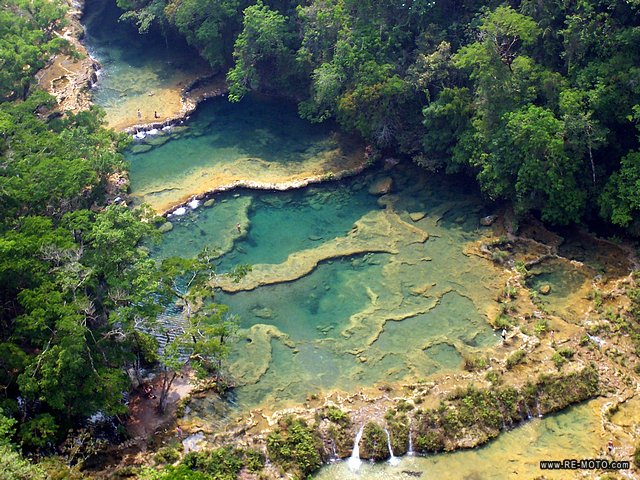
One of my favorite parts of Guatemala has been the constant presence of nature wherever I have been. Rugged mountains hug the shoulders of Barillas, there is always a snack nearby hanging from a banana tree or shooting from the ground in the form of a sugar cane stalk. Last night was a very special experience. Not a single cloud was in the sky (surprisingly) and the stars came out by the thousands. The Milky Way streaked across the dark sky, untainted by light poisoning from any nearby human city, where lights are never extinguished. I was even wished goodnight by our friend “ratón” who stalked the rafters of the schoolhouse and I was kept warm at night by a friendly little snake that curled up right under my mattress, though I didn’t realize it until the morning.
Sunday, July 19, 2009
Inauguracion Canton Las Maravillas
Inauguracion Canton Las Maravillas
As I mentioned before, during this past week I returned to the aldeas of Nuevo Santiago and Canton Las Maravillas so that Pete could see first-hand some of the work accomplished this year. Every year, HFPF has 6-7 groups that come down from January-June and the staff works not stop to prepare for the groups and ready the projects (this takes a lot of coordination. Imagine trying to pull off a public works project in a extremely poor community with no major power tools, organize hundreds of villagers, and then orient (and prepare for) the gringos that come down to live in the villages for just over a week at a time, for 6 straight months.)
But, all this work is worth it. During my few short visits to the aldeas I have seen (and tried to communicate) how important and impactful HFPF’s work is. On Monday, I got a very special opportunity to share in the community celebration for everything they have received. Canton Las Maravillas is a very poor village. There is no water in the village, so for years the people have had to walk over an hour to the river to wash their clothes and find water suitable to drink. Many households have built contraptions to collect rainwater. But these bins (they look like dog pens built of sticks, lined with black, plastic garbage bags) are only a site of algae growth, mosquito birthing grounds and home to millions of bacteria. This is the water that would be used to bathe in, water livestock, this is the water that would be used to drink and cook. The tinacas HFPF installed provide relatively clean water (supplemented by additional 5-gallon bucket filter apparatuses) and a safe way to store it. Let me put the importance of this project further in perspective. 8 or 9 (this is no exaggeration) out of 10 of the people who come to visit the Clinic Besthesda, where I have been working, have a gastrointestinal infection. They may come for a pregnancy check-up, a sinus infection, or some other health malady, but they may also complain of a stomach pain that has annoyed them for 2 months or 5 months or 2 years. Sure enough, a urine test or a one-time use H. pylori test confirms their stomach infection or stomach amoeba or parasite. The water tinacas allow villagers to drink clean water and wash their hands. The pig and garden projects in Nuevo Santiago diversify their diets and add important nutrients, protein, vitamins, and minerals. HFPF has moved away from treating the medical needs that HFPF originally served through Dr. Aller’s hands and guidance. Supporting a clinic is just too expensive and too difficult. But, HFPF’s work has been a perfect example to me of Public Health in action and preventative medicine. The water, nutrition, and educational projects will lower the number of people who come to the clinic. On Tuesday, when we visited Nuevo Santiago we interviewed the widows of the village and distributed quilts made by a Everett, Wa church (more on this in a later blog.) 3 of the 4 widows’ (or widowers) spouses died from vomiting and diarrhea. What bacteria caused that, they will never know. But, I know that the bacteria came from the unhealthy water or unsanitary conditions in which these people live.
Well, now onto the party. You may seen some interesting pictures on the side bar of what looks like a film set for a commercial for Nanoshine Onestep Wash and Polish, a revolutionary new, nanotechnology washing product that retains the same qualities of a car wax. Well, that because you did. Pete has recently started a new company selling this product, and he wanted to get some before and after material to help his advertising. So, we washed the cars with his product before taking off on our adventures. The roads we visited were the perfect place to test his product. A fun story. Who knows, you may see some of my filming on TV one day soon…
Well, the road up was even worse than before. This time there were 3 cars going up, one with the Barillas mayor (his district contains some 250 aldeas) and some government officials, the second with Marco, Pete, some Barillas Rotary members, and the third with Wily and I. Well, the road just got worse and worse with each car. All the villagers came out with their ropes and ponchos but after 2 and a half hours of driving Wily and I stopped the car, turned around and walked the rest of the way up.
This trip was also a mini-lesson for me of Guatemalan politics. Part of the reason the community invited the mayor was so that he could see first-hand how bad the road was, so that he could experience it for himself. Well, sure enough during the ceremony that followed he “publicly” promised to start working on the road. Next year. When they had more money. It’ll be interesting to see how this project proceeds. Just before you start ascending the last part of the mountain road to Canton, you come across a large river, with a cable bridge. Next to the bridge stands 3 hugs concrete foundational supports for a new bridge. Well, this project was started years ago, and then the money ran out, so the foundations now stick out of the water, supporting air. In Nuevo Santiago, the government brought in large concrete pipe sections to work on a drainage project, but the pieces sit in a field, unused. The government also started a smaller version of the garden project that HFPF initiated in Nuevo Santiago, but never returned to teach the villagers how to take care of the plants. Wily returns every week or two, to show them how to fertilize properly (directly on the plants, not in the middle of the rows) and safely, cover the radishes fruits that become uncovered because the seeds weren’t planted deep enough. The plants in the government garden have either died or the vegetables have grown too long and the few radishes left are only fit for pig feed.
Back to the party…
We were welcomed into the school by a lively Marimba band that filled the air with their sweety airy rhythms. We made our way over to a make-shift platform and a few plastic chairs, and the rest of the open space in the school was quickly filled by school children packed in like sardines. The rest of the village stood at the back or peeked in through the open windows. The ceremony was filled with the welcomes to every party there (the villagers, HFPF, the Barilas Rotary, the family of a Barillas pastor that joined us, the “Corporate Municipality” or local government, Pete and his grandson, myself) by almost every party there (I was the exception) so there was a lot of thank yous and welcomes and a lot of clapping. This was followed by certificates given out to all the various parties by the Corporate Municipality and the Canton Council President, and awards for the best decorated tinacas, best drawings, and the top finishers of the 5k race. (They started at the bottom of the mountain road just as we got there and beat us to the top, the gowing was so slow.) The best part was probably when the winner of the 5k race performed a song he had written himself about the tinaca water project and Marco, Wily, and the group that came to Canton. This funniest part was probably when Marco was explaining to the village how Pete had been the mayor of Everett when Bill Clinton had been president and Boeing had come to Everett. The mayor of Barillas immediately jumped up to have his picture taken with Pete.
Following the long ceremony, there was a great lunch, a soccer game (played in more of a bowl than what you would consider a soccer pitch), and dancing to the Marimba music. I wish I had made it over to the dancing, but I was trying to raise the spirit of the Barillas crowd who was unusually quiet for a futbol match in Central America (for that matter, anywhere outside the US.)
It was a fun-filled day. The people of Canton were so grateful and so happy for everything they had. And while they are so poor they really wanted to celebrate the help they had received. Marco and Wily each received a turkey for their work. Meat is a treat in the diet of the people of Canton. Turkey is a treat even for the more well off in Barillas. Wily’s family turned it into a great lunch which they shared with me, his pastor and his wife, his mother and father, and brother’s family. Marco eloquently explained ‘it’s a gift that’s hard to receive, but even harder to say ‘no’ to.”
The story behind the water project at Canton is particularly striking. Last year a Rotary group came down to build a school in Canton. Every day, they took showers from the water supplied to them by the villagers. At the end of the week, after the school was completed, the villagers told the group what they really needed was water. It took 2 hours to get water and the Rotary group had used up the entire village water supply. This heartbreaking story led to the tinaca project the village has now. The Rotary group went down with the villagers to collect more water before they left, and a year later every home has a tinaca to collect clean water. This project was very expensive and required a matching grant by Rotary International to come to fruition. With the current state of the economy, the number of matching grants has greatly decreased and HFPF was lucky to receive the money when they had. They won’t be able to complete such large projects in the future.
Now, I’m off to bed… Wily and I are going to a new aldea tomorrow, Corosco, and we are going to spend the night in the truckbed. I hope it doesn’t rain! (I’d say there’s a 80% chance…)
As I mentioned before, during this past week I returned to the aldeas of Nuevo Santiago and Canton Las Maravillas so that Pete could see first-hand some of the work accomplished this year. Every year, HFPF has 6-7 groups that come down from January-June and the staff works not stop to prepare for the groups and ready the projects (this takes a lot of coordination. Imagine trying to pull off a public works project in a extremely poor community with no major power tools, organize hundreds of villagers, and then orient (and prepare for) the gringos that come down to live in the villages for just over a week at a time, for 6 straight months.)
But, all this work is worth it. During my few short visits to the aldeas I have seen (and tried to communicate) how important and impactful HFPF’s work is. On Monday, I got a very special opportunity to share in the community celebration for everything they have received. Canton Las Maravillas is a very poor village. There is no water in the village, so for years the people have had to walk over an hour to the river to wash their clothes and find water suitable to drink. Many households have built contraptions to collect rainwater. But these bins (they look like dog pens built of sticks, lined with black, plastic garbage bags) are only a site of algae growth, mosquito birthing grounds and home to millions of bacteria. This is the water that would be used to bathe in, water livestock, this is the water that would be used to drink and cook. The tinacas HFPF installed provide relatively clean water (supplemented by additional 5-gallon bucket filter apparatuses) and a safe way to store it. Let me put the importance of this project further in perspective. 8 or 9 (this is no exaggeration) out of 10 of the people who come to visit the Clinic Besthesda, where I have been working, have a gastrointestinal infection. They may come for a pregnancy check-up, a sinus infection, or some other health malady, but they may also complain of a stomach pain that has annoyed them for 2 months or 5 months or 2 years. Sure enough, a urine test or a one-time use H. pylori test confirms their stomach infection or stomach amoeba or parasite. The water tinacas allow villagers to drink clean water and wash their hands. The pig and garden projects in Nuevo Santiago diversify their diets and add important nutrients, protein, vitamins, and minerals. HFPF has moved away from treating the medical needs that HFPF originally served through Dr. Aller’s hands and guidance. Supporting a clinic is just too expensive and too difficult. But, HFPF’s work has been a perfect example to me of Public Health in action and preventative medicine. The water, nutrition, and educational projects will lower the number of people who come to the clinic. On Tuesday, when we visited Nuevo Santiago we interviewed the widows of the village and distributed quilts made by a Everett, Wa church (more on this in a later blog.) 3 of the 4 widows’ (or widowers) spouses died from vomiting and diarrhea. What bacteria caused that, they will never know. But, I know that the bacteria came from the unhealthy water or unsanitary conditions in which these people live.
Well, now onto the party. You may seen some interesting pictures on the side bar of what looks like a film set for a commercial for Nanoshine Onestep Wash and Polish, a revolutionary new, nanotechnology washing product that retains the same qualities of a car wax. Well, that because you did. Pete has recently started a new company selling this product, and he wanted to get some before and after material to help his advertising. So, we washed the cars with his product before taking off on our adventures. The roads we visited were the perfect place to test his product. A fun story. Who knows, you may see some of my filming on TV one day soon…
Well, the road up was even worse than before. This time there were 3 cars going up, one with the Barillas mayor (his district contains some 250 aldeas) and some government officials, the second with Marco, Pete, some Barillas Rotary members, and the third with Wily and I. Well, the road just got worse and worse with each car. All the villagers came out with their ropes and ponchos but after 2 and a half hours of driving Wily and I stopped the car, turned around and walked the rest of the way up.
This trip was also a mini-lesson for me of Guatemalan politics. Part of the reason the community invited the mayor was so that he could see first-hand how bad the road was, so that he could experience it for himself. Well, sure enough during the ceremony that followed he “publicly” promised to start working on the road. Next year. When they had more money. It’ll be interesting to see how this project proceeds. Just before you start ascending the last part of the mountain road to Canton, you come across a large river, with a cable bridge. Next to the bridge stands 3 hugs concrete foundational supports for a new bridge. Well, this project was started years ago, and then the money ran out, so the foundations now stick out of the water, supporting air. In Nuevo Santiago, the government brought in large concrete pipe sections to work on a drainage project, but the pieces sit in a field, unused. The government also started a smaller version of the garden project that HFPF initiated in Nuevo Santiago, but never returned to teach the villagers how to take care of the plants. Wily returns every week or two, to show them how to fertilize properly (directly on the plants, not in the middle of the rows) and safely, cover the radishes fruits that become uncovered because the seeds weren’t planted deep enough. The plants in the government garden have either died or the vegetables have grown too long and the few radishes left are only fit for pig feed.
Back to the party…
We were welcomed into the school by a lively Marimba band that filled the air with their sweety airy rhythms. We made our way over to a make-shift platform and a few plastic chairs, and the rest of the open space in the school was quickly filled by school children packed in like sardines. The rest of the village stood at the back or peeked in through the open windows. The ceremony was filled with the welcomes to every party there (the villagers, HFPF, the Barilas Rotary, the family of a Barillas pastor that joined us, the “Corporate Municipality” or local government, Pete and his grandson, myself) by almost every party there (I was the exception) so there was a lot of thank yous and welcomes and a lot of clapping. This was followed by certificates given out to all the various parties by the Corporate Municipality and the Canton Council President, and awards for the best decorated tinacas, best drawings, and the top finishers of the 5k race. (They started at the bottom of the mountain road just as we got there and beat us to the top, the gowing was so slow.) The best part was probably when the winner of the 5k race performed a song he had written himself about the tinaca water project and Marco, Wily, and the group that came to Canton. This funniest part was probably when Marco was explaining to the village how Pete had been the mayor of Everett when Bill Clinton had been president and Boeing had come to Everett. The mayor of Barillas immediately jumped up to have his picture taken with Pete.
Following the long ceremony, there was a great lunch, a soccer game (played in more of a bowl than what you would consider a soccer pitch), and dancing to the Marimba music. I wish I had made it over to the dancing, but I was trying to raise the spirit of the Barillas crowd who was unusually quiet for a futbol match in Central America (for that matter, anywhere outside the US.)
It was a fun-filled day. The people of Canton were so grateful and so happy for everything they had. And while they are so poor they really wanted to celebrate the help they had received. Marco and Wily each received a turkey for their work. Meat is a treat in the diet of the people of Canton. Turkey is a treat even for the more well off in Barillas. Wily’s family turned it into a great lunch which they shared with me, his pastor and his wife, his mother and father, and brother’s family. Marco eloquently explained ‘it’s a gift that’s hard to receive, but even harder to say ‘no’ to.”
The story behind the water project at Canton is particularly striking. Last year a Rotary group came down to build a school in Canton. Every day, they took showers from the water supplied to them by the villagers. At the end of the week, after the school was completed, the villagers told the group what they really needed was water. It took 2 hours to get water and the Rotary group had used up the entire village water supply. This heartbreaking story led to the tinaca project the village has now. The Rotary group went down with the villagers to collect more water before they left, and a year later every home has a tinaca to collect clean water. This project was very expensive and required a matching grant by Rotary International to come to fruition. With the current state of the economy, the number of matching grants has greatly decreased and HFPF was lucky to receive the money when they had. They won’t be able to complete such large projects in the future.
Now, I’m off to bed… Wily and I are going to a new aldea tomorrow, Corosco, and we are going to spend the night in the truckbed. I hope it doesn’t rain! (I’d say there’s a 80% chance…)
Subscribe to:
Posts (Atom)