This is a short story. It’s also a true story. I call it a short story because it is a glimpse into the lives of the students here at St. Labre, specifically one student named James. While it is his unique experience, it also adds real insight to the larger issues many kids face on the reservation. James lived in the group home when he was younger.
Two of my housemates work in Shiloh, the group home, this year. They work, play and mentor the six elementary aged children currently living there. These are kids whose parents have lost custody or, in some cases, voluntarily bring their kids to stay at the home because of their own parenting challenges. Just two weeks ago, a mother brought her son to Shiloh with a mixed explanation of his unruly behavior and her own lack of parenting skills. She told him that when his behavior improved he could return home. Her son could not control his temper, often violently reacted to the other kids in the group home and as a result, he was not allowed to play with the other kids, and vice versa. His mom missed a scheduled appointment to drop off his things at Shiloh, only to return a week later to pick him on short notice and bring him home. Grandma and grandpa had convinced her that the little boy belonged at home. The administrators and counselors who run Shiloh had no control because she had retained custody throughout the entire affair.
While returning home was hard for the little boy (he cried, hid in the corner, not wanting to leave), it was also hard for the other kids living there. They had no home to return to and no mother or father to pick them up. This is part of the reality they face.
This year was James’ first back at St. Labre. Living according to the expectations at the dorm was difficult because he had experience many different home environments, including stints in jail. At first, he refused to respond to attendants requests for him to do his chores and make his bed, but slowly he came around. At first, he refused to do any homework in study hall, but then he slowly began to work, even if only in certain subjects. His behavior began to improve and it seemed the dorms were having a positive impact on him. Suddenly, he was gone from school for a week. After ten to fifteen unexcused absences from school students may be dismissed from St. Labre and James was asked to leave. It turns out the week he missed was spent in jail. I don’t know why he went to jail and I don’t know where he was headed after St. Labre. Most likely it will be one of the high schools on the reservation. While St. Labre isn’t perfect, it’s supposedly a much better institution than many of the other schools in the area. I will probably never see or hear from him again and I doubt his future will be easy. Before he left, he was given a heavy winter coat. He didn’t have anything thicker than a t-shirt to wear. This past week, it reached 3 degrees outside.
Last week, I chaperoned a wrestling match for the middle school. At the end of the night, we dropped many of the kids off at their homes. The final kid, Chris, we dropped off at a bar in Ashland. His grandmother worked inside and would take him home after her shift was over. He told me sometimes his family would not eat dinner until 11pm because his grandfather was drunk all the time, so his grandmother would have to work at the bar, and his uncle wouldn’t come home from work until 11 and then he would make dinner. Chris will probably come live in the dorm this next week. There are 70 other students who live at the dorm. Some may have stories and backgrounds similar to his. Some may not.
Showing posts with label poverty. Show all posts
Showing posts with label poverty. Show all posts
Wednesday, December 7, 2011

Tuesday, August 4, 2009
There's no place like home.

Tuesday, August 4th, 2009
I write from the comforts of the big red chair in the living room of my home in Snohomish, Washington. In the beautiful Pacific Northwest. The NW really is so beautiful. It is so great to be at home again with my family, my dogs, to walk around the beautiful garden, water the apple trees, to have fresh raspberries for my cereal and plump blueberries that I eat write off the bush.
I got home Sunday night around 10:30pm and have since spent the time relaxing.
My final destination in Guatemala, Lake Atitlan, was supposed to be filled with relaxation. However, while on a hike to Indian Nose (a mountain shaped in the pface of a person with a prominent nose), I was robbed and assaulted by 4 young men, 2 of whom were carrying machetes. I am okay :) but the experience was quite scary.
I had asked 2 people (one of whom was a guide) at the place I was staying if it was safe to do the hike alone. The response I got: "Yeah, you'll be okay. You're a man, they shouldn't bother you." Well, after hiking up the road for about just over an hour I started to catch up to a group of youth who were walking behind an older man. As they approached a blind corner, one looked back, spotted me and motioned to the others to stop. I noticed this and started to call out loudly (so they knew the older man knew I was there-or that was my intent), "Hey, how's it going? What are you guys up to?" One of the teens immediately pulled out a machete, pointed it at me and stalked towards me, saying: "Give me your money." I purposely didn't bring any money so this wouldn't happen and told him that. That didn't stop them from pulling my shirt up and sticking their hands under my belt (looking for a money belt) and into my pockets. I let them do so, out of pure shock and hoping that they would see I had no money and walk away. After repeating that I didn't have any money, the boy then said, "well, the backpack then" and another boy started to try to cut the straps off my backpack (which I was wearing) with his machete. This bolted me into action as my backpack had my camera in it. (My nice, new camera, but more importantly a lot of pictures that I had yet to save somewhere else) So, I grabbed the first thief's machete (which was inches from my face) and pushed away and tried to get away from their grasps. After a few attempts to run(it was impossible with 4 people holding onto different parts of me (trying to take off my watch) and my backpack I started to yell, "Thieves! Thieves, help me!" With this, I was able to break from their relaxed grasps and they ran off, up the hillside taking my room key and a bandanna from my pocket. I yelled in fury after them, "Hacen falta" (it's what fans cry after a foul in futbol, but I think I got my point across)
I am very grateful that God protected me during this incident and nothing worse happened. Their are stories of strong, grown men losing their shoes and shirt right off their back in past robberies.
A hundred meters up the road I met worker who offered to take me up to the top in safety for 5 bucks (the thieves don't attack when you're with a local), which I agreed to. We made it to the top and back down, without further incident. Though along the way we saw a few other young boys with machetes who Pablo, my guide, said were likely other potential thieves.
This was a horrible way to end my trip. I know the Guatemalan people are a beautiful, humble, giving people and they have shared so much with me even in the midst of their poverty. But, it is one part of the reality of this country, where corruption prevails in government and many people don't have jobs. Some of these people resort to theft. Maybe it is out of desperation to feed their families. In this case for these boys about my age, it was more likely out of want to buy an iPod or cellphone. Even in a country as poor as Guatemala, these modern symbols of luxury are everywhere.
Wednesday, July 22, 2009
Tragedy and Hope

Miercoles, 22 Julio 2009
Today was my first day at the clinic in about a week. When I got there, I learned that yesterday there had been a birth in the clinic. The mother had come in very weak. The baby was born feet first and the mother had no strength to push it out. One doctor had to pull on the baby’s legs while a nurse had to apply pressure to the mother’s stomach. The baby was born asphyxiated and purple. It took 4 or 5 minutes before they could get the baby to start breathing. (Lack of oxygen for this long causes serious brain damage that affects one for the rest of their life; from learning to walk to performing in the classroom.) This morning the little girl had a fever (around 39 ºC) when I came in, and after nursing a bottle of warm, purified water (the family couldn’t afford milk) she began to vomit it all back up, a brown mucus along with little bits of blood. We had to put a tube down her throat to her stomach to help siphon out the fluid because she didn’t have the strength to cough it all up. The doctors believe she has an infection from inhaling some of her feces as she was born (hence the brown color…) She fought the fever all day and at times the antibiotics quieted her crying. But, before the end of the day the fever came back and the poor little girl was burning up. The family decided they are going to take her home, while the doctors want her to stay or even go to a hospital. Part of the family’s wish may have to do with money. Dr. Rivas had no idea if the family was going to be able to pay for the medicine and treatment they had received over the past two days. (He also told me that at some clinics, they don’t let the patients leave until the bills are paid. This is not the case at the Clinica Bethesda; his first concern is the well-being of the patient. He figured the Clinica Bethesda has lost 3-4 million quetzals over the past 2-3 years from patients who have not been able to pay. Because of this, the clinic cannot buy the equipment they would like to or improve the clinic as fast They are currently constructing a new operating room, X-ray room, and lab room; the expected completion date is pretty far away.) It is expected that the baby girl will die without the medical care she needs as she has not been able to quit the fever, a sign of the infection she has. As I left the clinic tonight, I saw the father outside waiting to take her home.
While much of my blog has been touched by striking stories of poverty and hardship, there are two stories I wish to share that capture the hope that I have seen (which I also hope has been evident in my reaction to HFPF’s work.) Today I had lunch with a 10 year-old boy named Marcos. Every weekend, Marcos works on the street shining shoes to support his family. He used to do this every day until a woman came down with an HFPF group. While I don’t the name of this woman I do know she changed his life. After asking why he was out on the street and not in school and learning of his story, she ensured a fund was set up so that Marcos could go to school. This fund provides for his uniform, school supplies, and buys him lunch every weekday. We got ice cream after lunch and Marcos told me that he likes school; he eventually wants to go to college to read and ultimately become a professor or teacher.
On our journey to Barillas from Guate, Marco and I stopped along the way at a small aldea. We got out of the car and walked down a muddy path between two houses to get to the residence of Don Sebastian. Don Sebastian is a talented artisan wood carver. When he was young he had some sort of accident or illness and he can no longer walk. Still, through his beautiful craftsmanship and hard work he has put all 5 of his children through school and 3 are teachers. Don Sebastian is a great big man with a soft face and eyes that twinkle when he smiles. His giant hands lovingly carve beautiful figures of the Guatemalan people, capturing their struggle. A woman carrying water on her back or her head, a man hauling a huge load of firewood, a young girl carrying her little sister, wrapped in a shawl on her back.
Tuesday, July 21, 2009
Stories from Corozo

Lunes, 20 Julio 2009 - Martes, 21 Julio 2009
Monday morning Wily and I left for a new aldea, Corozo, where HFPF recently completed a stove Project. Many families in Guatemala cook over open fires in their homes, which is very dirty and unhealthy. It leads to respiratory problems (like asthma and bronchitis) and also affects pregnancies (birth weight, etc.)
This past Spring, Santa Clara University’s Ignatian Center and the Santa Clara Community Action program (SCCAP) helped me attend Unite for Sight’s Global Health Conference at Yale University. (At first read, you think “Wow!,” but it was actually so-so) But, there I met a nursing professor at UC Berkeley who is currently researching the effects of open, wood-burning fires on childhood respiratory health in Guatemala. Interesting stuff.
HFPF takes pride in their philosophy of working with the people, not just giving them donations. During the trip to Corozo, I witnessed the importance of the philosophy firsthand, multiple times. HFPF has an 80-90% success rate with their projects. This compares with an approximate 70% success rate with other organizations (such as those who build the stoves and then just install them in the villages w/o the relationships that HFPF takes pride in building).
The purpose of our trip to Corozo was to check every stove in the village (all 71 of them!) to make sure it was working properly (wasn’t broken), answer any questions, clean out the stove (and teach the families how to clean out the stoves for themselves), and make sure people were using them. Also, Wily had to check in with the villager’s payment plans. Corozo (like many other aldeas) has developed a culture that is used to receiving gifts from organizations that are trying to help the poor of Guatemala. However, this well-intentioned effort has had malicious consequences. Many of the previous projects do not last (one reason is because they are not taken care of, this could be to lack of education or lack of personal care and attention) In order to give the people of Corozo a sense of responsibility, pride, and ownership for their stoves, every stove owner must fulfill the contractual obligations of 5 monthly payments of 20 quetzales (for a total of 100Q or about $12.50 with the current exchange rate). Some people had yet to pay, so Wily had to remind them of the contract they signed. To help with his work, Wily hired two of the village council leaders to help assess each stove’s condition; each stop lasted 10-15 minutes. At the end of the day, one of the workers was trying to convince Wily to pay him 150Q instead of the 100Q they had agreed on previously. 100Q was the “just” wage for the day, but due to a culture affected by years of gifts (and maybe coupled with my presence as a Gringo- “someone who light skin, usually from the “other side,” and someone who can be counted upon to have money or valuables”) Gaspar thought he deserved more. Eventually, he and Wily worked things out after Wily offered Gaspar his “perspective.” Another interesting scenario resulted when (after dinner) we drove up to the school where we were to sleep for the night. A outside/open air meeting was just finishing up as we approached. Immediately after we parked, a few men swarmed the truck, picking through the stuff in the pick-up bed (our sleeping bags, mattresses, Wily’s bag, a pelota-soccer ball for the children) to see if we had brought them anything. One man asked (I don’t think he had seen the pelota), “Did you bring a pelota for us?” Wily replied that we hadn’t and just had one for the kids.
I offer the stories above as cultural observations. There could obviously be more factors to each situation and this is by no means a catch-all picture of all Guatemala. But, it offers some interesting insights to how we can best help those who are in need.
I want to share a few other experiences I had over the past two days:
Buda (pronounced “Bue-da,” means widow)

Pete brought some quilts from Faith Lutheran Church, which he attends, in Everett, Wa. These beautiful, warm quilts had been made by woman in the church and were meant to be given to widows and widowers in the villages HFPF works with. Every hand-made quilt carries the message, “Made With Love.” As the quilts were given to the widows, Wily gathered some information about the widow(er): his/her name, age(many villagers can’t remember their age and have to check their id card or just guess), number of children, when his/her spouse died and what happened. One woman shared a very poignant story. Her husband had died 25 years ago.
He had planned to go to the United States but didn’t tell his wife. He made it to San Mateo, a small city outside of Barillas. One day, after drinking, a bus drove by and he was pushed underneath and died from the accident. He left his wife to raise 7 children by herself. The death of a spouse not only steals a companion and lover, but in Guatemala it also leaves the burden of raising children, cleaning, cooking, gathering firewood, and farming all on one person. Many people’s spouses die after vomiting and diarrhea for days on end. Many families don’t have the money to take the patient to a see doctor. A few patients have come into the clinic and haven’t had any money to buy medicine. They return their village, knowing what disease plagues them, but not able to do a thing about it.
How hot is your Chu?

One of the most interesting parts of Monday was learning about Chus, small saunas, built with rocks to waist height. There were a few scattered around the homes of Corozo. As Gaspr explained it, Chus are a bit of indigenous medicine, to ease the pains and sores of a hard day’s work. Just like any other sauna I’ve been in, there is a small pile of rocks which are heated and to which water is added to create steam. There is small bench inside, but I don’t think I could sit up straight inside because the ceiling is so low. Usually the people will carry in a handful of reedy plants and hit the sore parts of their body (sometimes, they will just use their hands.) I wonder how saunas developed in Guatemala, if it is a cultural tradition that has been practiced for ages or if the notion was brought here from elsewhere (East Asia, the Mediterranean, etc.) It would be very interesting anthropological connection indeed if this human invention was born in various parts of the world by people who had no knowledge of each other.
A sad story
As we walked around the village evaluating the stoves, we were approached by a drunken man, who waved a piece of paper at us (which turned out to be a contract for an HFPF stove.) Wily explained to me that when the stove project was being organized in Corozo, the man got drunk and beat his wife. The village leaders decided that the stove should be placed in her name (most of the stove owners are the men/husbands.) So, she moved to a different house and how retains possession of the stove. I couldn’t understand a word the man sad (he was speaking in Q’anjo’bal), but apparently he was trying to get ownership of the stove.
The pools of Montenegra

On our way back from Corozo, we stopped to go swimming in a series of beautiful pools that have been molded from the rock by a flowing stream. The place was beautiful, a small sampling of Semuc Champey for those who have seen pictures or visited. The water, a brilliant, celeste-green color, flows from pool to pool and is quite warm. I imagine it must have been doing so for centuries to have sculpted the rock as it has. One can jump from pool to pool or sit under the small waterfalls at a pools’ edge for a massaging effect. It was so relaxing and refreshing!
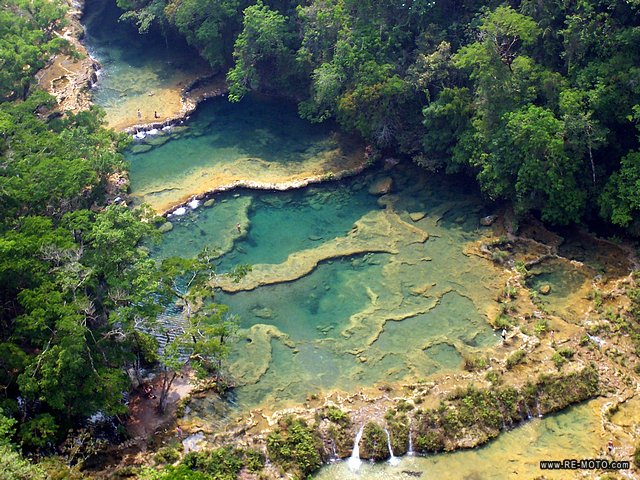
One of my favorite parts of Guatemala has been the constant presence of nature wherever I have been. Rugged mountains hug the shoulders of Barillas, there is always a snack nearby hanging from a banana tree or shooting from the ground in the form of a sugar cane stalk. Last night was a very special experience. Not a single cloud was in the sky (surprisingly) and the stars came out by the thousands. The Milky Way streaked across the dark sky, untainted by light poisoning from any nearby human city, where lights are never extinguished. I was even wished goodnight by our friend “ratón” who stalked the rafters of the schoolhouse and I was kept warm at night by a friendly little snake that curled up right under my mattress, though I didn’t realize it until the morning.
Sunday, July 19, 2009
Inauguracion Canton Las Maravillas
Inauguracion Canton Las Maravillas
As I mentioned before, during this past week I returned to the aldeas of Nuevo Santiago and Canton Las Maravillas so that Pete could see first-hand some of the work accomplished this year. Every year, HFPF has 6-7 groups that come down from January-June and the staff works not stop to prepare for the groups and ready the projects (this takes a lot of coordination. Imagine trying to pull off a public works project in a extremely poor community with no major power tools, organize hundreds of villagers, and then orient (and prepare for) the gringos that come down to live in the villages for just over a week at a time, for 6 straight months.)
But, all this work is worth it. During my few short visits to the aldeas I have seen (and tried to communicate) how important and impactful HFPF’s work is. On Monday, I got a very special opportunity to share in the community celebration for everything they have received. Canton Las Maravillas is a very poor village. There is no water in the village, so for years the people have had to walk over an hour to the river to wash their clothes and find water suitable to drink. Many households have built contraptions to collect rainwater. But these bins (they look like dog pens built of sticks, lined with black, plastic garbage bags) are only a site of algae growth, mosquito birthing grounds and home to millions of bacteria. This is the water that would be used to bathe in, water livestock, this is the water that would be used to drink and cook. The tinacas HFPF installed provide relatively clean water (supplemented by additional 5-gallon bucket filter apparatuses) and a safe way to store it. Let me put the importance of this project further in perspective. 8 or 9 (this is no exaggeration) out of 10 of the people who come to visit the Clinic Besthesda, where I have been working, have a gastrointestinal infection. They may come for a pregnancy check-up, a sinus infection, or some other health malady, but they may also complain of a stomach pain that has annoyed them for 2 months or 5 months or 2 years. Sure enough, a urine test or a one-time use H. pylori test confirms their stomach infection or stomach amoeba or parasite. The water tinacas allow villagers to drink clean water and wash their hands. The pig and garden projects in Nuevo Santiago diversify their diets and add important nutrients, protein, vitamins, and minerals. HFPF has moved away from treating the medical needs that HFPF originally served through Dr. Aller’s hands and guidance. Supporting a clinic is just too expensive and too difficult. But, HFPF’s work has been a perfect example to me of Public Health in action and preventative medicine. The water, nutrition, and educational projects will lower the number of people who come to the clinic. On Tuesday, when we visited Nuevo Santiago we interviewed the widows of the village and distributed quilts made by a Everett, Wa church (more on this in a later blog.) 3 of the 4 widows’ (or widowers) spouses died from vomiting and diarrhea. What bacteria caused that, they will never know. But, I know that the bacteria came from the unhealthy water or unsanitary conditions in which these people live.
Well, now onto the party. You may seen some interesting pictures on the side bar of what looks like a film set for a commercial for Nanoshine Onestep Wash and Polish, a revolutionary new, nanotechnology washing product that retains the same qualities of a car wax. Well, that because you did. Pete has recently started a new company selling this product, and he wanted to get some before and after material to help his advertising. So, we washed the cars with his product before taking off on our adventures. The roads we visited were the perfect place to test his product. A fun story. Who knows, you may see some of my filming on TV one day soon…
Well, the road up was even worse than before. This time there were 3 cars going up, one with the Barillas mayor (his district contains some 250 aldeas) and some government officials, the second with Marco, Pete, some Barillas Rotary members, and the third with Wily and I. Well, the road just got worse and worse with each car. All the villagers came out with their ropes and ponchos but after 2 and a half hours of driving Wily and I stopped the car, turned around and walked the rest of the way up.
This trip was also a mini-lesson for me of Guatemalan politics. Part of the reason the community invited the mayor was so that he could see first-hand how bad the road was, so that he could experience it for himself. Well, sure enough during the ceremony that followed he “publicly” promised to start working on the road. Next year. When they had more money. It’ll be interesting to see how this project proceeds. Just before you start ascending the last part of the mountain road to Canton, you come across a large river, with a cable bridge. Next to the bridge stands 3 hugs concrete foundational supports for a new bridge. Well, this project was started years ago, and then the money ran out, so the foundations now stick out of the water, supporting air. In Nuevo Santiago, the government brought in large concrete pipe sections to work on a drainage project, but the pieces sit in a field, unused. The government also started a smaller version of the garden project that HFPF initiated in Nuevo Santiago, but never returned to teach the villagers how to take care of the plants. Wily returns every week or two, to show them how to fertilize properly (directly on the plants, not in the middle of the rows) and safely, cover the radishes fruits that become uncovered because the seeds weren’t planted deep enough. The plants in the government garden have either died or the vegetables have grown too long and the few radishes left are only fit for pig feed.
Back to the party…
We were welcomed into the school by a lively Marimba band that filled the air with their sweety airy rhythms. We made our way over to a make-shift platform and a few plastic chairs, and the rest of the open space in the school was quickly filled by school children packed in like sardines. The rest of the village stood at the back or peeked in through the open windows. The ceremony was filled with the welcomes to every party there (the villagers, HFPF, the Barilas Rotary, the family of a Barillas pastor that joined us, the “Corporate Municipality” or local government, Pete and his grandson, myself) by almost every party there (I was the exception) so there was a lot of thank yous and welcomes and a lot of clapping. This was followed by certificates given out to all the various parties by the Corporate Municipality and the Canton Council President, and awards for the best decorated tinacas, best drawings, and the top finishers of the 5k race. (They started at the bottom of the mountain road just as we got there and beat us to the top, the gowing was so slow.) The best part was probably when the winner of the 5k race performed a song he had written himself about the tinaca water project and Marco, Wily, and the group that came to Canton. This funniest part was probably when Marco was explaining to the village how Pete had been the mayor of Everett when Bill Clinton had been president and Boeing had come to Everett. The mayor of Barillas immediately jumped up to have his picture taken with Pete.
Following the long ceremony, there was a great lunch, a soccer game (played in more of a bowl than what you would consider a soccer pitch), and dancing to the Marimba music. I wish I had made it over to the dancing, but I was trying to raise the spirit of the Barillas crowd who was unusually quiet for a futbol match in Central America (for that matter, anywhere outside the US.)
It was a fun-filled day. The people of Canton were so grateful and so happy for everything they had. And while they are so poor they really wanted to celebrate the help they had received. Marco and Wily each received a turkey for their work. Meat is a treat in the diet of the people of Canton. Turkey is a treat even for the more well off in Barillas. Wily’s family turned it into a great lunch which they shared with me, his pastor and his wife, his mother and father, and brother’s family. Marco eloquently explained ‘it’s a gift that’s hard to receive, but even harder to say ‘no’ to.”
The story behind the water project at Canton is particularly striking. Last year a Rotary group came down to build a school in Canton. Every day, they took showers from the water supplied to them by the villagers. At the end of the week, after the school was completed, the villagers told the group what they really needed was water. It took 2 hours to get water and the Rotary group had used up the entire village water supply. This heartbreaking story led to the tinaca project the village has now. The Rotary group went down with the villagers to collect more water before they left, and a year later every home has a tinaca to collect clean water. This project was very expensive and required a matching grant by Rotary International to come to fruition. With the current state of the economy, the number of matching grants has greatly decreased and HFPF was lucky to receive the money when they had. They won’t be able to complete such large projects in the future.
Now, I’m off to bed… Wily and I are going to a new aldea tomorrow, Corosco, and we are going to spend the night in the truckbed. I hope it doesn’t rain! (I’d say there’s a 80% chance…)
As I mentioned before, during this past week I returned to the aldeas of Nuevo Santiago and Canton Las Maravillas so that Pete could see first-hand some of the work accomplished this year. Every year, HFPF has 6-7 groups that come down from January-June and the staff works not stop to prepare for the groups and ready the projects (this takes a lot of coordination. Imagine trying to pull off a public works project in a extremely poor community with no major power tools, organize hundreds of villagers, and then orient (and prepare for) the gringos that come down to live in the villages for just over a week at a time, for 6 straight months.)
But, all this work is worth it. During my few short visits to the aldeas I have seen (and tried to communicate) how important and impactful HFPF’s work is. On Monday, I got a very special opportunity to share in the community celebration for everything they have received. Canton Las Maravillas is a very poor village. There is no water in the village, so for years the people have had to walk over an hour to the river to wash their clothes and find water suitable to drink. Many households have built contraptions to collect rainwater. But these bins (they look like dog pens built of sticks, lined with black, plastic garbage bags) are only a site of algae growth, mosquito birthing grounds and home to millions of bacteria. This is the water that would be used to bathe in, water livestock, this is the water that would be used to drink and cook. The tinacas HFPF installed provide relatively clean water (supplemented by additional 5-gallon bucket filter apparatuses) and a safe way to store it. Let me put the importance of this project further in perspective. 8 or 9 (this is no exaggeration) out of 10 of the people who come to visit the Clinic Besthesda, where I have been working, have a gastrointestinal infection. They may come for a pregnancy check-up, a sinus infection, or some other health malady, but they may also complain of a stomach pain that has annoyed them for 2 months or 5 months or 2 years. Sure enough, a urine test or a one-time use H. pylori test confirms their stomach infection or stomach amoeba or parasite. The water tinacas allow villagers to drink clean water and wash their hands. The pig and garden projects in Nuevo Santiago diversify their diets and add important nutrients, protein, vitamins, and minerals. HFPF has moved away from treating the medical needs that HFPF originally served through Dr. Aller’s hands and guidance. Supporting a clinic is just too expensive and too difficult. But, HFPF’s work has been a perfect example to me of Public Health in action and preventative medicine. The water, nutrition, and educational projects will lower the number of people who come to the clinic. On Tuesday, when we visited Nuevo Santiago we interviewed the widows of the village and distributed quilts made by a Everett, Wa church (more on this in a later blog.) 3 of the 4 widows’ (or widowers) spouses died from vomiting and diarrhea. What bacteria caused that, they will never know. But, I know that the bacteria came from the unhealthy water or unsanitary conditions in which these people live.
Well, now onto the party. You may seen some interesting pictures on the side bar of what looks like a film set for a commercial for Nanoshine Onestep Wash and Polish, a revolutionary new, nanotechnology washing product that retains the same qualities of a car wax. Well, that because you did. Pete has recently started a new company selling this product, and he wanted to get some before and after material to help his advertising. So, we washed the cars with his product before taking off on our adventures. The roads we visited were the perfect place to test his product. A fun story. Who knows, you may see some of my filming on TV one day soon…
Well, the road up was even worse than before. This time there were 3 cars going up, one with the Barillas mayor (his district contains some 250 aldeas) and some government officials, the second with Marco, Pete, some Barillas Rotary members, and the third with Wily and I. Well, the road just got worse and worse with each car. All the villagers came out with their ropes and ponchos but after 2 and a half hours of driving Wily and I stopped the car, turned around and walked the rest of the way up.
This trip was also a mini-lesson for me of Guatemalan politics. Part of the reason the community invited the mayor was so that he could see first-hand how bad the road was, so that he could experience it for himself. Well, sure enough during the ceremony that followed he “publicly” promised to start working on the road. Next year. When they had more money. It’ll be interesting to see how this project proceeds. Just before you start ascending the last part of the mountain road to Canton, you come across a large river, with a cable bridge. Next to the bridge stands 3 hugs concrete foundational supports for a new bridge. Well, this project was started years ago, and then the money ran out, so the foundations now stick out of the water, supporting air. In Nuevo Santiago, the government brought in large concrete pipe sections to work on a drainage project, but the pieces sit in a field, unused. The government also started a smaller version of the garden project that HFPF initiated in Nuevo Santiago, but never returned to teach the villagers how to take care of the plants. Wily returns every week or two, to show them how to fertilize properly (directly on the plants, not in the middle of the rows) and safely, cover the radishes fruits that become uncovered because the seeds weren’t planted deep enough. The plants in the government garden have either died or the vegetables have grown too long and the few radishes left are only fit for pig feed.
Back to the party…
We were welcomed into the school by a lively Marimba band that filled the air with their sweety airy rhythms. We made our way over to a make-shift platform and a few plastic chairs, and the rest of the open space in the school was quickly filled by school children packed in like sardines. The rest of the village stood at the back or peeked in through the open windows. The ceremony was filled with the welcomes to every party there (the villagers, HFPF, the Barilas Rotary, the family of a Barillas pastor that joined us, the “Corporate Municipality” or local government, Pete and his grandson, myself) by almost every party there (I was the exception) so there was a lot of thank yous and welcomes and a lot of clapping. This was followed by certificates given out to all the various parties by the Corporate Municipality and the Canton Council President, and awards for the best decorated tinacas, best drawings, and the top finishers of the 5k race. (They started at the bottom of the mountain road just as we got there and beat us to the top, the gowing was so slow.) The best part was probably when the winner of the 5k race performed a song he had written himself about the tinaca water project and Marco, Wily, and the group that came to Canton. This funniest part was probably when Marco was explaining to the village how Pete had been the mayor of Everett when Bill Clinton had been president and Boeing had come to Everett. The mayor of Barillas immediately jumped up to have his picture taken with Pete.
Following the long ceremony, there was a great lunch, a soccer game (played in more of a bowl than what you would consider a soccer pitch), and dancing to the Marimba music. I wish I had made it over to the dancing, but I was trying to raise the spirit of the Barillas crowd who was unusually quiet for a futbol match in Central America (for that matter, anywhere outside the US.)
It was a fun-filled day. The people of Canton were so grateful and so happy for everything they had. And while they are so poor they really wanted to celebrate the help they had received. Marco and Wily each received a turkey for their work. Meat is a treat in the diet of the people of Canton. Turkey is a treat even for the more well off in Barillas. Wily’s family turned it into a great lunch which they shared with me, his pastor and his wife, his mother and father, and brother’s family. Marco eloquently explained ‘it’s a gift that’s hard to receive, but even harder to say ‘no’ to.”
The story behind the water project at Canton is particularly striking. Last year a Rotary group came down to build a school in Canton. Every day, they took showers from the water supplied to them by the villagers. At the end of the week, after the school was completed, the villagers told the group what they really needed was water. It took 2 hours to get water and the Rotary group had used up the entire village water supply. This heartbreaking story led to the tinaca project the village has now. The Rotary group went down with the villagers to collect more water before they left, and a year later every home has a tinaca to collect clean water. This project was very expensive and required a matching grant by Rotary International to come to fruition. With the current state of the economy, the number of matching grants has greatly decreased and HFPF was lucky to receive the money when they had. They won’t be able to complete such large projects in the future.
Now, I’m off to bed… Wily and I are going to a new aldea tomorrow, Corosco, and we are going to spend the night in the truckbed. I hope it doesn’t rain! (I’d say there’s a 80% chance…)
Saturday, July 18, 2009
You scream, I scream, we all scream for Ice Cream!


Sabado, 18 Julio 2009
The last week has been a busy one, and lots of fun! Pete Kinch, the executive director of HFPF and his grandson, Aaron, joined us here in Barillas. Marco Tulio went to Guatemala City to pick them up and also brought along his nephew, Chris, from San Marcos, which is along the way. I feel bad for Marco, he has made the 11-hour trip between Guate and here (or segments over two days’ time) at least 4 times in the past 2 weeks!
It was great fun to have more people in the Mission House (as Marco stays in the “pilot house” in the back) with two young kids running around and home cooked meals! Lydia, a women who lives locally, came to cook meals for us from Saturday to Wednesday! And boy was the food good! A mix of foods from home (like Spaghetti, though I have had that here once already), food I don’t normally get in the restaurant (like fresh-from-the-oven-homemade bread!!) and always lots of it. I was living the good life!! Though, thankfully, the transition from Lydia’s cooking hasn’t been too rough. Today for lunch I was invited to Wily’s house for Turkey (a treat! and a gift from Canton Las Maravillas, more on that later) and good soup.
And last night, I went to Yupi Café with two friends I have made here- Elise (from Redmond, who will attend SPU next year. Hannah if you’re reading this, I told her to find you!) and Claudia (who lives in Guate but works in Barillas for parts of the year. They took off this morning so we dined out on queso hamburguesas, hot chocolate, and ice cream! Yupi Café has been at times a refuge for me. One particular day, the food at the restaurant was just not very good. (since then, things have been better…) From the first bite of hot cereal at breakfast, there was something wrong. That day I had a measly lunch of PB&J sandwiches and by dinner I was pretty hungry!! It had been raining most of the day and I wanted something warm! I hadn’t been able to find hot chocolate anywhere in Barillas except at Yupi Café, so I headed straight there. I had a huge dinner of a cheeseburger, (I also had a craving for French fries, and while popular in Guatemala Yupi doesn’t have them) tamales, with my hot chocolate-warm, rich, and sweet! Another day, again the cheeseburger and ice-cream topped with chocolate and nuts fulfilled my comfort food craving. I loved eating all sorts of new meals and foods. But at times, ice cream just hits the spot like nothing else. And the people of Barillas appreciate that, too! I've tried a few flavors of homemade ice cream-cocunut and peanut, and a few more "bars" sit up in the freezer waiting for a hot afternoon!
...
So, I thought it might be a nice place to take Elise, not knowing what she had been eating during her 6+ week stay in Barillas. (It turns out Claudia and she cooked in their home; microwave chicken, instant mashed potatoes, rice, etc.) Then, after dinner, we met went next door to get ice-cream (they have better ice-cream than Yupi). In the midst of ordering our cones, we were met by the two little, poor boys I had blogged about earlier, and who I had seen various nights in Barillas. We offered them ice cream instead of a quetzal handout, which they asked for, and then we had a lot of fun sitting and eating with them.
This was the first time I had been able to talk with them. I had bought one of them ice cream before and he ran away soon after getting it. After asking them why they were out so late at night, running around the city, the more talkative of the two responded that “there was no older man in the house to tell him not to” We learned they live with their mother and can’t afford the necessary books, uniforms, and other supplies to go to school. It was a very sad reality. We spelled the various words on the ice-cream advertisements (they were 8 and 10-years old, no schooling, and spoke mostly Q’anjob’al) and they joked around with each other and us. At one point, the little (and more talkative) one, Mura? (I think it’s an indigenous name) went digging in the garbage to find someone’s else left-over ice cream treat to enjoy. I started to stop him, but then realized maybe he didn’t have dinner that night. Like, I said a very sad reality to be in the midst of, to watch and bear. I’m glad Claudia got a few pictures, which they got a kick out (asking for just a picture of their sandals) to remember them by. Though, their memories will not soon slip from my memory.
The Mission House is now empty and much quieter. When Pete (the big jefe) came, the entire house was cleaned, covers taken off of couches and loveseats, and the big dining room table and chairs set up, with a beautiful table cloth to boot. Everything has been packed away, floors swept and mopped one last time and the house is in hibernation mode until groups return in January. It almost felt like a vacation to have other bodies around 24/7. My tocayo, Chris, (Tocayo is a Spanish word used when two people have the same name) was quite a character. Only 8 years old (and skipping school for this trip!), Chris was frank and honest with his thoughts and emotions. For the first few meals, he would get up in the middle of eating, walk into the kitchen and ask Lydia if she was going to come eat because the food was getting cold. Then, five minutes later, after she hadn’t come, he would ask again if she was going to come eat with us. Very sweet and a great personality! He and Aaron (just as all the aldea children do when we visited, the “little princess” at the Quinceanera, and the two little boys we shared ice cream with) lightened up my experience in a very special, fun way!
Stay tuned for more updates about our special trip to Canton Las Maravillas! We returned with Pete for a big party and “inauguration” of the tinaca project. It was a very special day to share with Marco, Wily, Pete, and the people of Canton Las Maravillas.
Saturday, July 11, 2009
Barillas Time

It seems like I am always behind on posting.
On Friday, Wily and I went to Canton (=aldea) Las Maravillas. It was a LONG day! HFPF recently finished a water project there, installing 84 tinacas (LARGE-like 200 gallon or more, black plastic tanks) and roofing system to collect clean, rain water. Before, community members (usually women) had to walk 2 hours or more to a river to get water because there aren't any springs nearby. Think of how big a deal this is! (What time and energy the people have back in their lives! And the water is so much cleaner!) The slogan of the company that makes the tinacas is "mas y mejor agua" (=more and better water). Now every family has a tinaca and the community has 42 to share as well when it doesn't rain as often. In order to follow up with this project, everybody decorated their tinacas and added a "thank-you" message to HFPF, the volunteer groups who went down and built the concrete pads and roof system, and installed the tinacas, and the various Rotary groups who helped sponsor the project (Club Rotarias Huehuetenango, Club Rotario Everett-Port Gardner, Club Rotario White Rock Peninsula). Wily and I went around and took pictures of all of them and then we "calificar"-ed them (picked the best ones) today.
But, before we even got to Canton it was an adventure. The last 2 km of the road to Canton is the worst: mud, hilly, sharp (as in 180*) turns, rocks. We barely made it to Canton. 40 of the villagers had to push and (literally, with ropes) pull us up the mountain. And, we almost didn't make it down alive because it had rained a lot in the afternoon before we left. I said over 50 prayers yesterday.
The houses are pretty spread out so we had to walk a ton; it was really hot early on in the day and I was sweating! The situation turned comical though, as we were offered hot milk and a rest at one house. A hot drink on a hot day! Only in Central America!! Then, we had a lunch of hot pollo criollo soup (it's chicken that has only eaten corn-so it tastes better in a broth with a few big vegetables). To top it off I added some picas (hot peppers) to taste the real cultural thing. I couldn't cut open the green, less ripe (and less spicy) pepper with my spoon as Wily was, so I chose a more mature, red pepper which was softer. And as they say, pica mucho!! Still after a hot and spicy lunch on a hot day, I was able to sit back and rest for a while, and really just be with the people and experience life as they live it. But, there in that wood hut, after eating lunch while sweating and with my nose running, I was able to sit back and estuve contento pincho (another indigenous term I learned that day, it means that I was content to the depths of my heart...)
We finally finished all the houses at 6 and got off the bad mountain roads before it was completely dark. It felt to get back and relax, shower, do laundry. I woke up a little late today...
But today was also a lot of fun. After grading the tinacas this morning and a short English lesson I left for Claudia(a new friend)'s house at 3:45 (like I was supposed to so we could leave at 4 for a wedding). Our ride didn't show up until 4:30 and we got to the wedding at 3:45 where of course they gave seats in the very front row by placing seats right in front of the bride's parents. Bizarre, I know. I didn't realize where the ushers were leading us until it was too late. It was very embarrassing but there was nothing I could do but try and enjoy the ceremony. Three gringos (I was also with Elise who is from Redmond and Chris McCormick from Snohomish, who I have met down here), front row center at a traditional wedding where the bride and bride's maid and multiple flower girls were wearing traje tradicional. We left the wedding early (in the middle of a HUGE rainstorm, it was like being under a waterfall) for a quinceañerawhich was supposed to start at 5:00, but didn't start until 7:15 when the birthday girl showed up. I was joking with Wily who is a padrino (god-father) about being on "God's time." (we only had to wait for a little while cuz we got there at 6:40). And then we didn't eat until 8:45...
I had a lot of fun after the formal ceremonial part of the quinceañera was over. During dinner I sat next to 10 year-old Gabby, who was one of the attendants. She was beautiful in her pink dress and curls. We talked, clowned around, and played with squishy balls in the flower vases. I was happy that I got a few pictures with the princess afterwards.
The events of today have given me a new appreciation for my family who is consistently late to large, significant events. Though to everyone's credit, we are getting better...
Marco Tulio brought Pete Kinch, the exec. director of HFPF into Barillas today from Guate. (That's an 11-hour drive, which he has done 4 times in just over the past 2 weeks!) I was describing my day and he put it perfectly, "There's Guatemalan time and there's Barillas time!"
Wednesday, July 1, 2009
Martes 29 Juno 2009
I have made an agreement with a local restaurant to get my meals at a lower price than normal, 15 quetzales. The exchange rate is about 8.5, so that makes every meal just under two dollars, plus any drinks I order. The restaurant is run by a mother and her 4 daughters (I’m guessing) between the ages of 15 and 25? The mom is out of town until tomorrow (Wednesday). The food isn’t as great as the other Guatemalan food I’ve eaten, but it’s much cheaper and I’ve only just started to test the menu. Who knows, I may start to experiment and frequent other restaurants that don’t look too shady. My other option is to cook. The mission house of HFPF is quite spacious and has two kitchens and all the necessary equipment, but I think cooking for myself would just take too much time. Besides, today we went to the market to buy some fruit and I don’t think I could eat any meat I would buy there as it all sits in the open in the heat of the day with no ice. This is probably the same market that supplies my carne asada and pollo ahumado(smoked chicken) but I least I don’t know about it.
Along with watermelon and grapes from the market, I bought some homemade ice cream to put in the freezer from a house Marco pointed out. I also visited a panaderia for same empanadas y conchas and picked up some Gatorade, cashews, and a packet of cookies at the super (mini grocery store). The Gatorade is to replenish the fluids I am losing from my biological introduction to Guatemala. I don’t know if the diarrhea is just from the new microbes or from my waitress’s sniffles, runny nose, and the use of her all too serviceable hand. !Bienvenidos!
When I am driving in the US and I see a homeless person on a street corner I will give them food if I have it and sometimes a few dollars. Food cannot hurt and while the money may go to drugs or alcohol, this may be due to circumstances beyond my control. Maybe this excuse is just a cop-out for my conscience and my thoughtful gift will actually do more harm than good, but I also realize I live a very blessed life and can spare a few dollars for someone who needs it.
They are so poor, they obviously need some money. But, if I do, will they come back every night to ask me for another? I can’t give them a quetzal every night. Well, I can, but is this really doing any good? Does it just reinforce a stereotype that causes them to ask every Gringo this question? Or, have I just created this stereotype in my head and these two boys ask everyone in Barillas this question.
Along with watermelon and grapes from the market, I bought some homemade ice cream to put in the freezer from a house Marco pointed out. I also visited a panaderia for same empanadas y conchas and picked up some Gatorade, cashews, and a packet of cookies at the super (mini grocery store). The Gatorade is to replenish the fluids I am losing from my biological introduction to Guatemala. I don’t know if the diarrhea is just from the new microbes or from my waitress’s sniffles, runny nose, and the use of her all too serviceable hand. !Bienvenidos!
When I am driving in the US and I see a homeless person on a street corner I will give them food if I have it and sometimes a few dollars. Food cannot hurt and while the money may go to drugs or alcohol, this may be due to circumstances beyond my control. Maybe this excuse is just a cop-out for my conscience and my thoughtful gift will actually do more harm than good, but I also realize I live a very blessed life and can spare a few dollars for someone who needs it.
They are so poor, they obviously need some money. But, if I do, will they come back every night to ask me for another? I can’t give them a quetzal every night. Well, I can, but is this really doing any good? Does it just reinforce a stereotype that causes them to ask every Gringo this question? Or, have I just created this stereotype in my head and these two boys ask everyone in Barillas this question.
Subscribe to:
Posts (Atom)