Showing posts with label nature. Show all posts

Friday, February 17, 2012

Road Trip!!

We left Ashland at 4am Friday morning.

First stop: Sunrise at Devil's tower


The U.S.'s first declared National Monument; it rises 1,267 feet above the surrounding terrain and the summit is 5,112 feet above sea level.


The iPad!


Kellie and Kathryn helping Jimmy take photos...


Then we were on to Crazy Horse. This monument to the famous Lakota warrior has been under private construction since 1948. When it is finished, it will stand 641 feet wide and 563 feet high. The head of Crazy Horse will be 87 feet high; by comparison, the heads of the four U.S. Presidents at Mount Rushmore are each 60 feet high.


By the time afternoon rolled around Bryan was happy to see Mt. Rushmore and his hero, honest Abe.


The iPad is back!


How many photos does it take to get a good group shot?


Two?


Third time's the charm?


Nope, four?


Surely by number five?


Number six it is...


And seven is even better (from L-R,Jimmy, Meredith, Kristin, Kathryn, Tony, Bryan, Me and Kellie)


A spectacular monument


And on to a much needed rest in Rapid City, SD


An added bonus, here's a few photos from last weekend's retreat weekend in Great Falls...

On the way there, we checked out downtown Helena:


And Our Lady of Helena Cathedral:


The Ursuline Retreat Center is home to a school and also served as a convent:


Here's our entire group, incl. JVs from Hays, Billings, St. Xavier and Us:


On our way back, we stopped at First People's Buffalo Jump outside of GF:


Prior to the introduction of horses to the plains, 14 different tribes would travel from hundreds of miles away to harvest buffalo by driving them over the edge of a sheer cliff:


One runner wearing a buffalo calf hide would draw the lead cow towards the cliff, until they were close enough for the entire tribe to stampede them over the edge. The runner had to be agile enough to make it to the edge first and find a crevice for cover of the stampeding herd.

Tuesday, October 11, 2011

Sweat

Fall is truly here. Friday was the first rainy day we have had since we’ve been here. Throughout the summer we had a few thunderstorms; dark clouds rolled in announced by thunderous cracks followed by flashing bursts of light. Heavy rain might shower down for 15 minutes or so but never any longer than 30 minutes. In contrast, the Friday sky was grey and cloudy all day and reminded me of the beautiful fall weather back home that makes you want to curl up by a fire with a good book and a cup of hot chocolate.

After a few hours of training at school (we’ve been learning self-defense and use of force to defuse violent situations by a former cop. I thought it was going to be a class that would teach us methods of de-escalation (i.e. non-violent forms like mediation) to defuse tension, which in my perspective would have been more helpful. Instead the course was geared towards those situations you avoid where a student resorts to violence. At times this may happen, and has happened to various degrees, in the school here. Remember, these kids come from damaged homes where physical violence or at least verbal abuse is common. Often, our students may not learn the healthy forms of self expression we all take for granted. In some ways, this class was a direct consequence of Columbine, and the factors that contributed. In that sense, it is important. Also, knives and guns are very common in the rural Montana culture because the majority of people hunt-and usually to put food on the table. I am not trying to make a moral judgment of that culture in any way. However, I think the majority of our time and effort, including our training, should focus on what we do during 99.9% of our work hours, if not 100% of the time on the job: Creating an environment where kids learn healthy, non-violent ways to deal with intra- and inter-personal conflict, stress, and emotion. We need to set our students up to make the good decision, so they do not feel they have to resort to a situation where violence is necessary.) Anyways, enough about that… So once again, we journeyed to Billings to run errands, shop for groceries and to pick up Meredith’s Mom, Diane, and her friend, Carol, for the weekend. The entire time it drizzled and we had a cozy drive in to town.

On Sunday, we went trail riding for a few hours. I had so much fun-it was one of the best things we’ve done so far, and I could not get over how beautiful the country is-the Cottonwood leaves were dressed in their Autumn best-shades of orange, yellow, red, green and brown, and the green pines stood out against the golden wild grasses. We climbed a bluff West of the school to a beautiful lookout where you could see both valleys stretching out below. To our East you could make out the Tongue River, snaking its way below, lined with blooming Cotton woods, and to the West the golden valley floor stretched for miles and miles until it reached a “mountain range” in the distance (the mountains in SE Montana rise like the foothills in Washington). My horse, named Max, was a little antsy, so when I first got on he was a littler ornery and didn’t want to listen to directions. He trotted off in all different directions and I had to really rein him in. But, this just got my blood pumping and made the experience a little more fun. Most of my housemates had never ridden before, though one of them is a pretty experienced rider. She and I would hold back occasionally, giving our horses plenty of space to take off and trot or lope for a bit. It tried our horses’ patience, but I hope they also had fun getting a little speed. We both also offered to help out around the rancher’s place, take care of his horses, and even ride them (hint, hint… ;) ) if need be. He thought he could find some work for us, so hopefully there will be more riding in the future!

Richard Tallbull took us to Medicine Rock on Saturday and also coordinated the trail riding the following day. Richard is a Southern Cheyenne Indian who was born and raised in Oklahoma by white parents and Indian grandparents. As such, he did not really learn about Cheyenne culture until he moved out to Montana and the Northern Cheyenne reservation. Since then, he has learned the language, culture and history of the Cheyenne people. Medicine Rock is the site of numerous pictographs, pictures and symbols left behind by Indians who lived near here or passed through the area. Richard showed us all number of animals: elk, deer, bear, turtles and lizards, human people, teepees, medicine bags and other symbols. The tribal identities of human figures are differentiated so that Cheyenne are distinct from Arapahos, women are distinguished from men, and holy men from warriors. One of the more “famous” pictographs on Medicine rock is the depiction of a vision Sitting Bull had at a Sun Dance ceremony before the Battle of Little Bighorn: “Soldiers and some Indians on horseback coming down like grasshoppers, with their heads down and their hats falling off. They were falling right into [their] camp.” Sitting Bull interpreted this as a sign of success in the ensuing Battle of the Little Bighorn, Custer’s Last Stand.

Richard has also invited us to participate in sweats in the local community. Sweat lodges have been used in numerous cultures throughout history. When I traveled in the NW highlands of Guatemala two summers ago, I saw concrete and earthen sweat lodges used by the indigenous people. In contrast to the Plains Indians, it is my understanding that the Guatemalan people use their lodges to relieve pain, hitting themselves with reeds in sore areas. The sweat lodges of the Native American people are places of prayer, chapels of God’s creation close to Mother Earth.

Richard estimated that sweats have been around since the 16th century. The lodges, where the sweats take place, are round domes made of willow branches lashed together and covered with some type of insulated material. Historically, sweats were only used by medicine men; these ceremonial sweats, as Richard calls them are much smaller, fitting only a few men. They are still in use today, “off in the hills” for certain ceremonial purposes. Often, these spiritual men pray for the tribe or the needs of certain individuals. With time the modern co-ed sweat evolved for warriors who desired a place to pray before heading out on a war party. The young man’s sweat, as Richard commonly refers to it, is much larger (fitting 12-15 individuals if everyone slides in together) and is a place for all to pray: men, women, young old, Indian, white and everyone in between. It has been a very special privilege for me to attend the sweat that Ernie and Mary Jane Robinson put on every Sunday. Mary Jane is a teacher at St. Labre and Ernie works at the Cheyenne tribal housing authority.

Historically, sweat lodges were covered with buckskin. The Robinson’s sweat lodge is covered by large blankets and comforters and the dirt ground is lined with carpet. Everyone sits around the edge of a three foot pit that is dug in the center. The hosts of the sweat sit near the front door that faces to the East and the women sit on the Southern side. Going around the circle, the men sit on the Northern side, and any holy men sit on the other side of the Eastern door, along with the rock man. The rock man uses a pitchfork to gather large lava rocks that have been heated for a few hours in the fire and brings them in the center pit before each of the four ‘rounds.’ The rocks are called the Grandfathers, because they are so old, too old to really know their age, born long before any of us. Ernie reminds us that they will also live long after us, part of the Maheyote’s (God) creation. Each of the four parts of the circle (the hosts, the women, the men, the holy men and rock man) takes a round to pray. One may thank and pray for the host, the rock man, those who helped to prepare the sweat (chopping wood, gathering rocks, etc.) or prepared food for the potluck afterwards. One may also pray for their own needs and special intentions.

I have found this experience to be so special. Whatever is said at the sweat remains in that circle, and MJ often reminds us that the rocks are so old that they have experienced more than anything we will tell them and so we should not have fear. A deep sense of community is created as people bring their vulnerable selves-sharing their needs and brokenness, as much or little of their humanness as they choose to. Cedar is sprinkled on the rocks, emitting a fragrant smoke for everyone to bless themselves and the doors are pulled shut, sending everyone into complete darkness. The men lead the prayer songs, shaking a gourd to keep time and singing in their native language as the women sing along, while members of the circle give their pray aloud, or in silence, whatever they desire.

The heat reaches higher than any sauna I have ever been into. We estimated the temperature from 125-130º. (On a side note: I know you’re probably thinking, “Is this safe?” This is spiritual practice that has been around for hundreds of years. In fact, it is believed the Native people even used sweating as a form of medicine; I read somewhere that bacteria and viruses cannot survive at a temperature much higher than our internal body temp. The organic ingenuity, the practice of sustainable practices (like the respect for Salmon that causes Indian to return the filleted body to the streams, enriching the forest and stream beds with important nutrients) or medical knowledge they have accumulated, of Native cultures continues to astound me.

Richard has often reminded me to pay attention to what we are here for in the sweat, to our prayers and to whom we are praying to, God. I have found this focus on my prayers or the music helps to make the heat more bearable during the 6-10 minute round. My first time in the dark and music of the sweat was a surreal, almost psychedelic experience. The stark contrast of complete darkness shocked my body as I began to feel the extreme heat waves flow over my body. Then, the music began; songs that sounded as if they had been around from the beginning of creation, in a language that was as organic as the rocks in the center of the pit, the gourd shaking moving these prayers out of our bodies as the sweat ran down our skin. I found my head starting to spin from the sensory overload and I had to close my eyes (most of the time now I sweat with my eyes closed), and focus on the rhythm of the music so I would not pass out. The heat feels much less harsh after 3 weeks of sweating and in a way, is therapeutic. Every sweat is different. Sometimes the rounds are longer, sometimes the heat is more intense as an entire bucket of water is poured over the rocks. Richard tells me that for him, certain sweats may be draining if not everyone is singing and he feels like he has to sustain the entire circle for four rounds. I can very much see how that could be, and am very grateful for those who sustain the sweats-Richard, MJ and Ernie- though for me (and this is part of why I am so grateful), every sweat rejuvenates me and heals me. They say the sweat exiting our pores is the poison and bad spirits leaving our body and soul. I find this to be very true, similar to how a good run or workout can rejuvenate you mentally and emotionally, though I do not diminish the spiritual importance of the sweat.

Again, I just have to say how grateful I am for the invitation to this community-the sweats, the culture, the lives of this people.

Thursday, July 30, 2009

The road...

Jueves, 30 Agosto 2009

I write from the Black Cat Hostel in Antigua. It´s the middle of my week of travelling Guatemala to see a little more of the country. Sunday Willy and Sandra and I drove from Barillas to Guatemala City (12 hours), all seated in the front of a pick-up truck. Let´s just say I was glad when it was over...

They dropped me off at a bus company in the City where I was to begin my first leg of the journey. Upon a friend´s advice I had booked all my travels through a tourist travel company because it would be safer and I would have my entire itinerary set. Trying to do the country in a week leaves no time for missed buses and extra nights somewhere.

When I got to the bust station I was met by a travel agency rep holding a sign with my name. I paid him the total for all my travels, he pocketed the money and then went to the ticket counter a few feet away and bought my bus ticket from the bus company for almost half the price I paid him!! I was immediately upset. At myself because I realized how I had led myself into this. At the company for charging such an exuberant price for a service that I could have easily accomplished if I had known about it.

Well, you live and you learn. Next time I travel I trust myself more to find the bargains I know I can and do my own ticket shopping. And, next time I will not try to see an entire country in only a week!

The 9pm overnight bus (a charter bus, I slet pretty well and was happy I wasn´t paying for a hotel that night) took us to Flores, a small island town outside of Tikal. We got off the bus at 5am and were immediately surrounded by bus drivers who offered us hotel rooms or wanted to take us to where we going. This time, though, I was ready. I said, no I already have a hotel (I didn´t) and I knew where I was going (I didn´t) unless they wanted to take me there for free, which they didn´t.

Since Sunday night I have reverted back to my bargain-minded (some people might call it ´cheap´) self, constantly trying to make up for the money I´ve wasted.

Tikal was magnificent. We got there in the afternoon as most people were leaving and got to explore the ruins with the general absence of other people. I saw the monkeys clowning around in the trees and then watched as they came down to run on the ground (at times on just 2 legs-it was like watching Planet of the Apes) which was cool. I bribed the guards to watch the sunset from Temple IV after the park officially closed and rose at 3:45 for a tour to the Temples to hear the jungle wake up. Again. we had to bribe the guards to get in before the park officially opens at 6.

From Tikal I came here and climbed Volcan Pacaya last night, which was very cool! We got up close and roasted marshmallows over the lava (though I could also feel the skin on my cheeks roasting, it was HOT!!). Today I have explored Antigua a little more (it´s a very pretty little colonial town and has great architecture and ruins. But, there´s also a huge gringo population and most of the shops have the same feel.

At Lake Atitlan, I will relax for a few days before returning to Guate on Sunday. It will be great to just sit back and enjoy the lake after the past few busy days of travel and bus long bus rides.

I wish I could upload pictures and offer a better description of the things I´ve seen, but don´t have enough time.

The past week of moving around the country has made me value even more the experience in Barillas because I was truly able to get to know the city, the people, and the Guatemalan culture. I was able to share food and spend time in the villages, and come to know the struggles facing the poor communities and Guatemala as a country in general. This light-speed travelling barely gives me a taste of each place I visit.

I guess I will just have to come back again to see all the places I have missed and get to know the country a littl better.

Tuesday, July 21, 2009

Stories from Corozo


Lunes, 20 Julio 2009 - Martes, 21 Julio 2009

Monday morning Wily and I left for a new aldea, Corozo, where HFPF recently completed a stove Project. Many families in Guatemala cook over open fires in their homes, which is very dirty and unhealthy. It leads to respiratory problems (like asthma and bronchitis) and also affects pregnancies (birth weight, etc.)

This past Spring, Santa Clara University’s Ignatian Center and the Santa Clara Community Action program (SCCAP) helped me attend Unite for Sight’s Global Health Conference at Yale University. (At first read, you think “Wow!,” but it was actually so-so) But, there I met a nursing professor at UC Berkeley who is currently researching the effects of open, wood-burning fires on childhood respiratory health in Guatemala. Interesting stuff.

HFPF takes pride in their philosophy of working with the people, not just giving them donations. During the trip to Corozo, I witnessed the importance of the philosophy firsthand, multiple times. HFPF has an 80-90% success rate with their projects. This compares with an approximate 70% success rate with other organizations (such as those who build the stoves and then just install them in the villages w/o the relationships that HFPF takes pride in building).

The purpose of our trip to Corozo was to check every stove in the village (all 71 of them!) to make sure it was working properly (wasn’t broken), answer any questions, clean out the stove (and teach the families how to clean out the stoves for themselves), and make sure people were using them. Also, Wily had to check in with the villager’s payment plans. Corozo (like many other aldeas) has developed a culture that is used to receiving gifts from organizations that are trying to help the poor of Guatemala. However, this well-intentioned effort has had malicious consequences. Many of the previous projects do not last (one reason is because they are not taken care of, this could be to lack of education or lack of personal care and attention) In order to give the people of Corozo a sense of responsibility, pride, and ownership for their stoves, every stove owner must fulfill the contractual obligations of 5 monthly payments of 20 quetzales (for a total of 100Q or about $12.50 with the current exchange rate). Some people had yet to pay, so Wily had to remind them of the contract they signed. To help with his work, Wily hired two of the village council leaders to help assess each stove’s condition; each stop lasted 10-15 minutes. At the end of the day, one of the workers was trying to convince Wily to pay him 150Q instead of the 100Q they had agreed on previously. 100Q was the “just” wage for the day, but due to a culture affected by years of gifts (and maybe coupled with my presence as a Gringo- “someone who light skin, usually from the “other side,” and someone who can be counted upon to have money or valuables”) Gaspar thought he deserved more. Eventually, he and Wily worked things out after Wily offered Gaspar his “perspective.” Another interesting scenario resulted when (after dinner) we drove up to the school where we were to sleep for the night. A outside/open air meeting was just finishing up as we approached. Immediately after we parked, a few men swarmed the truck, picking through the stuff in the pick-up bed (our sleeping bags, mattresses, Wily’s bag, a pelota-soccer ball for the children) to see if we had brought them anything. One man asked (I don’t think he had seen the pelota), “Did you bring a pelota for us?” Wily replied that we hadn’t and just had one for the kids.

I offer the stories above as cultural observations. There could obviously be more factors to each situation and this is by no means a catch-all picture of all Guatemala. But, it offers some interesting insights to how we can best help those who are in need.

I want to share a few other experiences I had over the past two days:

Buda (pronounced “Bue-da,” means widow)
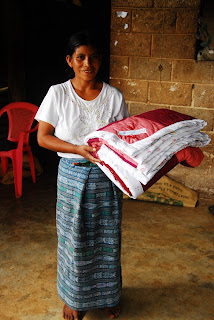

Pete brought some quilts from Faith Lutheran Church, which he attends, in Everett, Wa. These beautiful, warm quilts had been made by woman in the church and were meant to be given to widows and widowers in the villages HFPF works with. Every hand-made quilt carries the message, “Made With Love.” As the quilts were given to the widows, Wily gathered some information about the widow(er): his/her name, age(many villagers can’t remember their age and have to check their id card or just guess), number of children, when his/her spouse died and what happened. One woman shared a very poignant story. Her husband had died 25 years ago.
He had planned to go to the United States but didn’t tell his wife. He made it to San Mateo, a small city outside of Barillas. One day, after drinking, a bus drove by and he was pushed underneath and died from the accident. He left his wife to raise 7 children by herself. The death of a spouse not only steals a companion and lover, but in Guatemala it also leaves the burden of raising children, cleaning, cooking, gathering firewood, and farming all on one person. Many people’s spouses die after vomiting and diarrhea for days on end. Many families don’t have the money to take the patient to a see doctor. A few patients have come into the clinic and haven’t had any money to buy medicine. They return their village, knowing what disease plagues them, but not able to do a thing about it.

How hot is your Chu?


One of the most interesting parts of Monday was learning about Chus, small saunas, built with rocks to waist height. There were a few scattered around the homes of Corozo. As Gaspr explained it, Chus are a bit of indigenous medicine, to ease the pains and sores of a hard day’s work. Just like any other sauna I’ve been in, there is a small pile of rocks which are heated and to which water is added to create steam. There is small bench inside, but I don’t think I could sit up straight inside because the ceiling is so low. Usually the people will carry in a handful of reedy plants and hit the sore parts of their body (sometimes, they will just use their hands.) I wonder how saunas developed in Guatemala, if it is a cultural tradition that has been practiced for ages or if the notion was brought here from elsewhere (East Asia, the Mediterranean, etc.) It would be very interesting anthropological connection indeed if this human invention was born in various parts of the world by people who had no knowledge of each other.

A sad story
As we walked around the village evaluating the stoves, we were approached by a drunken man, who waved a piece of paper at us (which turned out to be a contract for an HFPF stove.) Wily explained to me that when the stove project was being organized in Corozo, the man got drunk and beat his wife. The village leaders decided that the stove should be placed in her name (most of the stove owners are the men/husbands.) So, she moved to a different house and how retains possession of the stove. I couldn’t understand a word the man sad (he was speaking in Q’anjo’bal), but apparently he was trying to get ownership of the stove.

The pools of Montenegra


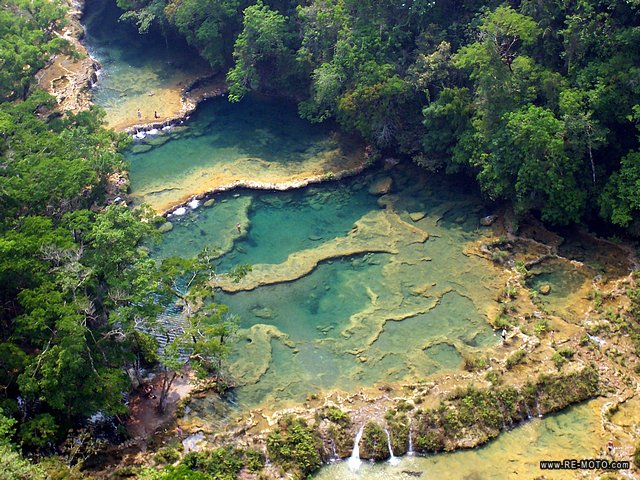
On our way back from Corozo, we stopped to go swimming in a series of beautiful pools that have been molded from the rock by a flowing stream. The place was beautiful, a small sampling of Semuc Champey for those who have seen pictures or visited. The water, a brilliant, celeste-green color, flows from pool to pool and is quite warm. I imagine it must have been doing so for centuries to have sculpted the rock as it has. One can jump from pool to pool or sit under the small waterfalls at a pools’ edge for a massaging effect. It was so relaxing and refreshing!

One of my favorite parts of Guatemala has been the constant presence of nature wherever I have been. Rugged mountains hug the shoulders of Barillas, there is always a snack nearby hanging from a banana tree or shooting from the ground in the form of a sugar cane stalk. Last night was a very special experience. Not a single cloud was in the sky (surprisingly) and the stars came out by the thousands. The Milky Way streaked across the dark sky, untainted by light poisoning from any nearby human city, where lights are never extinguished. I was even wished goodnight by our friend “ratón” who stalked the rafters of the schoolhouse and I was kept warm at night by a friendly little snake that curled up right under my mattress, though I didn’t realize it until the morning.